English
 عربى

The LS355-1A Electric Metal Cut-Off Machine is designed for workshops, fabrication facilities, construction sites, maintenance departments, automotive repair centers, and manufacturing environments that require fast, accurate, and repeatable material cutting. Built around a 355 mm cutting blade, the machine provides a practical solution for cutting steel, aluminum, pipes, rods, bars, profiles, conduit, and other commonly used materials. Its combination of cutting performance, stable construction, operator-oriented controls, and safety features makes it suitable for both professional production work and demanding maintenance applications.
Metal cutting is often one of the first and most important steps in fabrication. The quality of a cut affects assembly accuracy, welding preparation, material consumption, production speed, and the final appearance of a finished product. A machine that produces inconsistent cuts can increase rework, waste valuable material, and create unnecessary safety risks. The LS355-1A is developed to address these challenges through a robust mechanical structure, a powerful motor system, controlled blade rotation, vibration reduction, and convenient operation.
For buyers comparing cut-off machines, the most important considerations are not limited to motor power or blade diameter. Long-term value also depends on structural stability, ease of maintenance, safety protection, cutting consistency, portability, manufacturing quality, and the supplier’s ability to provide dependable production and technical support. The LS355-1A is positioned as a balanced machine that combines these requirements in a compact and practical format.
Overview of the LS355-1A Electric Metal Cut-Off Machine
The LS355-1A is an electrically powered metal cut-off machine intended for efficient cross-cutting operations. It uses a 355 mm cutting blade, a size widely adopted for workshop and industrial cutting tasks because it offers a useful balance between cutting capacity, accessibility, and machine portability. The blade can be used for a broad selection of applications involving metal and, with the correct compatible blade, certain other materials.
The machine is built for operations in which stock material must be divided into accurate lengths. Typical workpieces include metal rods, pipes, tubes, flat bars, angle sections, steel profiles, aluminum components, electrical conduit, and plumbing materials. Its cutting mechanism is designed to provide a clean and controlled cut while limiting unnecessary material loss.
A major benefit of a dedicated cut-off machine is repeatability. Handheld cutting tools can be useful for mobile work, but they may require more operator effort to maintain a straight cut. A bench-mounted or floor-positioned cut-off machine provides a defined cutting path and a stable working platform. This helps operators achieve more consistent results, especially when processing multiple pieces of similar material.
The LS355-1A also incorporates features intended to support extended use. Its sturdy frame helps reduce movement during cutting, while vibration control improves operator comfort and contributes to a more stable cutting action. Protective equipment around the blade helps reduce exposure to sparks and fragments, and overload protection supports safer operation when the machine is used under demanding conditions.
| Item | Product Information |
|---|---|
| Product type | Electric metal cut-off machine |
| Model | LS355-1A |
| Blade diameter | 355 mm |
| Primary applications | Metal rods, pipes, bars, profiles, conduit, and fabrication materials |
| Compatible material categories | Steel, aluminum, and other suitable metals |
| Operating characteristics | Stable cutting, adjustable cutting angles, quick blade replacement, and controlled operation |
| Safety provisions | Blade guard, overload protection, and emergency stop function |
| Construction focus | Heavy-duty frame, vibration control, and heat-resistant components |
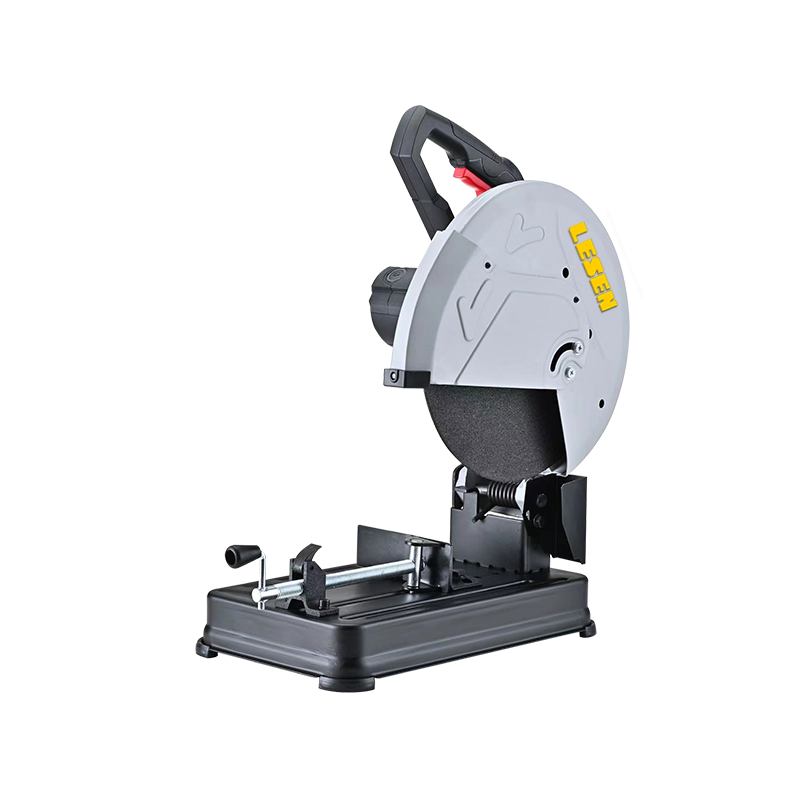
LS355-1A Electric Metal Cut Off Machine
Advantages Over Conventional and Competing Cutting Solutions
Consistent Cutting Accuracy
One of the clearest advantages of the LS355-1A is its ability to support consistent cutting accuracy. In fabrication and maintenance work, the objective is not simply to separate one piece from another. The cut must often be made at a specified length and angle so that the part can be assembled, welded, installed, or processed further without excessive adjustment.
The machine’s stable construction and defined cutting movement help reduce the variation that can occur with less controlled cutting methods. A stable workpiece and a properly aligned blade contribute to cleaner results. This is especially useful when operators need to process a batch of similar parts or prepare several components for a common assembly.
Compared with improvised cutting arrangements or handheld tools used without adequate support, a dedicated cut-off machine can reduce operator fatigue and improve repeatability. More consistent cuts can reduce the need for grinding, trimming, or corrective work after cutting. This may improve overall productivity even when the individual cutting cycle appears similar to that of another machine.
Efficient Use of Material
Material waste is a significant concern in metalworking. Every inaccurate cut can reduce the usable length of a stock piece, while excessive vibration or poor blade control may produce rough edges that require additional finishing. The LS355-1A is designed to support smooth cutting and controlled material removal, helping users make better use of their raw materials.
Efficient material use is particularly important when working with expensive alloys, long steel profiles, aluminum sections, or production orders involving large quantities of stock. A reliable cutting process allows operators to plan cut lengths more confidently and reduce the frequency of discarded pieces caused by avoidable errors.
The machine does not eliminate kerf loss, blade wear, or normal cutting waste, but its controlled design helps users manage these factors more effectively. Selecting the correct blade and applying suitable pressure remain essential to achieving the best results.
Power Under Load
The LS355-1A is equipped with a high-powered motor system intended to deliver consistent energy to the cutting blade. Cutting metal places changing demands on a motor. The load can increase when the blade enters a thicker section, encounters a harder material, or is operated with excessive downward pressure. A suitable motor system helps maintain productive cutting performance under these changing conditions.
Stable power delivery can also improve the operator’s experience. When a machine struggles excessively under load, the cutting process can become slower and less predictable. In contrast, a motor designed for demanding use supports a more consistent working rhythm. This is valuable in professional environments where time, repeatability, and throughput are important purchasing criteria.
The machine’s speed-control capability allows the cutting process to be adjusted according to the requirements of different materials and applications. Operators should use the recommended settings and compatible blades for the workpiece being processed. Correct speed selection can help balance cutting speed, edge quality, blade life, and heat generation.
Heavy-Duty Stability
Machine stability is a central factor in accurate cutting. A lightweight or poorly balanced structure may shift during operation, particularly when the workpiece is large or the cutting force changes. The LS355-1A uses a sturdy frame intended to remain stable during normal cutting operations.
Structural stability provides several benefits. It helps maintain the alignment between the blade and workpiece, reduces unwanted movement, and gives the operator a more controlled cutting feel. It can also reduce the chance of rough or angled cuts caused by machine movement. For workshops that process long lengths of material, the cut-off machine should be positioned on a stable surface and used with suitable external supports where necessary.
The heavy-duty build also contributes to durability. Components that are exposed to repeated mechanical loads, vibration, heat, and workshop dust must be selected and assembled with care. A robust structure can help the machine withstand regular use and reduce premature wear when operators follow appropriate maintenance procedures.
Reduced Vibration and Improved Comfort
Vibration can affect both cut quality and operator comfort. Excessive vibration may cause the workpiece to move, increase blade wear, create rougher edges, and make extended operation tiring. The LS355-1A incorporates a design intended to reduce vibration during cutting.
Lower vibration can make it easier for the operator to control the cutting movement. It also supports a more comfortable working environment, particularly when several cuts are made during a shift. Operator comfort is not merely a convenience; it can influence concentration, handling accuracy, and safe working behavior.
Vibration control depends on more than the machine frame. The blade must be correctly installed, the workpiece must be properly secured, and the machine must be placed on a stable surface. A damaged, unbalanced, or incorrectly selected blade can create vibration even when the machine itself is in good condition.
Convenient Blade Replacement
Production efficiency is affected by maintenance time. When a blade becomes worn or must be changed for a different material, a complicated replacement procedure can create unnecessary downtime. The LS355-1A is designed to allow quick and straightforward blade changes.
Fast replacement helps workshops return to operation more quickly. It also encourages operators to replace worn blades instead of continuing to use them beyond their effective service life. A sharp and suitable blade generally produces better results than a damaged or heavily worn blade, and it can reduce the amount of force required during cutting.
Blade replacement should always be performed with the machine disconnected from the power supply and in accordance with the applicable operating instructions. The new blade must be compatible with the machine, correctly oriented, properly tightened, and inspected before use.
Compact and Relatively Portable Design
Industrial capability does not always require a large fixed machine. Many workshops have limited floor space, while construction and maintenance teams may need to move equipment between workstations. The LS355-1A is designed to occupy relatively little space while retaining a heavy-duty structure.
Its compact form can make it easier to integrate into different workshop layouts. It may be positioned near a fabrication bench, material storage area, assembly station, or maintenance zone, provided that adequate clearance and safe operating space are maintained.
The machine is also described as relatively lightweight for its class, which supports movement between suitable work areas. Portability can be an advantage for contractors, service departments, and facilities that handle changing projects. Even so, safe lifting and transportation practices should be followed, and the machine should be secured during movement.
Detailed Product Features
355 mm Cutting Blade
The 355 mm blade size is a practical standard for a broad range of metal cut-off work. It provides useful cutting reach without requiring the footprint of a much larger industrial saw. This makes the machine suitable for general fabrication, repair, installation, and preparation work.
Blade diameter alone does not define the maximum practical cutting capacity. The actual result depends on the material profile, workpiece geometry, blade type, cutting angle, machine configuration, and manufacturer recommendations. Operators should consult the applicable product instructions and never force a workpiece that exceeds the machine’s intended capacity.
Using the correct blade is essential. Abrasive blades, carbide-tipped blades, and other cutting products may have different operating requirements. The blade must be selected for the material and installed according to its direction of rotation and mounting specifications.
Adjustable Cutting Angles
Many fabrication tasks require more than a simple 90-degree cut. Frames, supports, piping systems, brackets, and structural components may require miters or other angled cuts. The LS355-1A provides adjustable cutting angles to support a wider range of applications.
Adjustability improves the versatility of the machine. Instead of requiring a separate tool for every orientation, operators can prepare workpieces for different assembly requirements using the same basic cutting platform. Accurate angle adjustment is especially useful when fabricating repeated components or preparing joints for welding.
Before cutting at an angle, the workpiece should be firmly secured and the angle-setting mechanism should be checked. A small error in the setup can be repeated across an entire batch, so careful alignment is important.
Protective Blade Guard
The protective guard around the cutting blade is an important safety feature. It helps limit accidental contact with the rotating blade and provides a barrier against sparks, chips, and fragments generated during operation. The guard should remain correctly installed and must never be removed or modified in a way that reduces protection.
Operators should also use suitable personal protective equipment, including safety glasses or a face shield, hearing protection, protective footwear, and appropriate work clothing. Gloves may be required for handling sharp stock material, but they must be selected and used in a manner consistent with safe machine operation.
Overload Protection
Overload protection is designed to help prevent damage when the machine experiences excessive demand. Overloading may result from cutting unsuitable material, applying excessive downward force, using a dull blade, or operating under conditions that cause the motor to heat rapidly.
This feature supports equipment durability, but it should not be treated as a substitute for correct operation. If the protection system activates repeatedly, the operator should stop and identify the cause. Possible causes include an inappropriate blade, a jammed workpiece, inadequate ventilation, electrical supply problems, or excessive cutting pressure.
Emergency Stop Function
An emergency stop function allows the operator to stop the machine quickly when an unexpected condition occurs. This can be important if the workpiece shifts, the blade becomes damaged, abnormal vibration appears, or another unsafe situation develops.
Operators should understand the location and operation of the emergency stop before beginning work. The area around the control should remain accessible and free from obstruction. After an emergency stop, the cause of the problem should be investigated before the machine is restarted.
Heat-Resistant Components
Cutting operations naturally generate heat. Heat may result from friction between the blade and workpiece, motor operation, abrasive action, or insufficient cutting conditions. Components designed to tolerate elevated operating temperatures help support consistent performance during extended use.
Heat resistance is most effective when combined with sensible operating practices. The operator should avoid forcing the blade, maintain suitable ventilation, keep cooling or airflow paths clear where applicable, and allow the machine to rest when operating conditions require it. Excessive heat can shorten the service life of motors, bearings, blades, and electrical components.
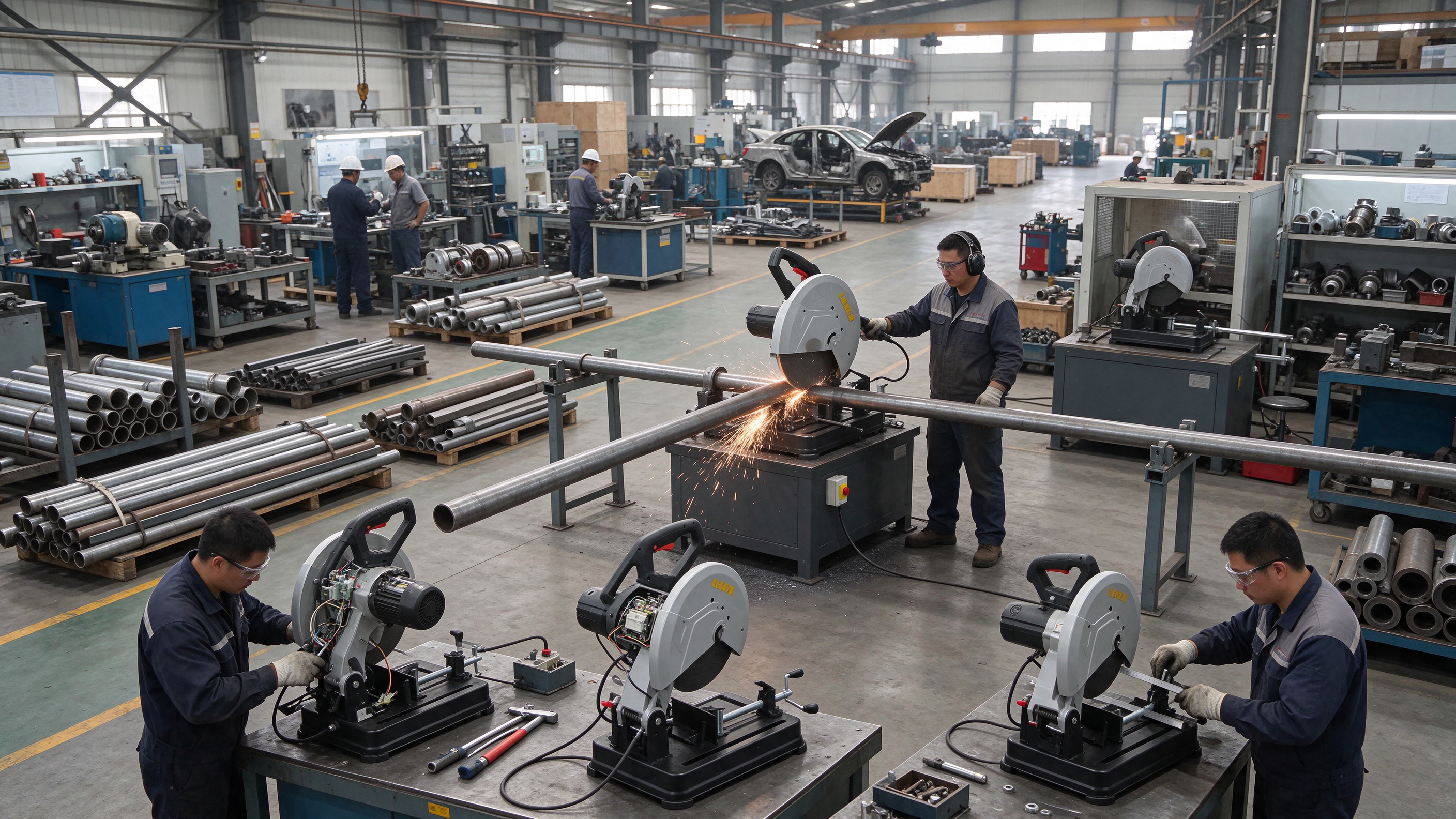
Applications Across Professional Industries
Metal Fabrication
Fabrication shops use cut-off machines to prepare raw material before welding, drilling, bending, or assembly. The LS355-1A can be used for cutting rods, pipes, bars, channels, and other profiles into manageable or specified lengths.
Fabricators benefit from the machine’s repeatability and angle adjustment. Components can be prepared according to drawings or production requirements, helping reduce the amount of manual correction required before assembly. A stable cut also provides a better starting point for welding and finishing.
Construction and Structural Work
Construction projects often require steel and aluminum materials to be cut on site or in a preparation area. The machine can support work involving structural sections, pipes, conduit, support frames, and other metal components.
Its relatively compact design is useful where space is limited. Contractors can position the machine in a designated cutting area while maintaining a clear separation between cutting, storage, and installation activities. The machine should be protected from unsuitable weather exposure and operated on a stable, level surface.
Automotive Repair and Manufacturing
Automotive workshops frequently need to cut brackets, tubing, exhaust-related components, metal supports, and replacement parts. The LS355-1A can help technicians prepare materials for repair and modification work.
In automotive manufacturing or component preparation, repeatability is important because multiple pieces may need to be cut to matching dimensions. The machine’s controlled cutting action and adjustable angle capability can support the preparation of components for frames, fixtures, stands, and repair assemblies.
Electrical and Plumbing Installation
Electrical and plumbing work often involves cutting conduit, pipes, support rails, brackets, and other metal installation materials. A dedicated cut-off machine can make this work faster and more consistent than manual methods.
Clean, accurately sized cuts simplify fitting and joining. For installers, the ability to prepare several pieces efficiently can improve productivity during workshop preparation or larger installation projects. The workpiece must be supported correctly, especially when cutting long or flexible lengths.
General Manufacturing
Manufacturers use cut-off machines to divide incoming stock into blanks for subsequent operations. These blanks may be drilled, turned, milled, welded, pressed, or assembled later in the production process.
The LS355-1A can be used as part of a broader material-preparation workflow. Its value is greatest when the cutting process is organized with clear material specifications, repeatable setups, suitable blade selection, and inspection procedures. For higher-volume production, the machine may be integrated into a work cell with material supports and standardized operator instructions.
Maintenance and Repair Departments
Industrial maintenance teams often need to make replacement parts or modify existing metal components quickly. A compact cut-off machine can provide an efficient in-house cutting capability without requiring every component to be outsourced.
This can reduce waiting time and support faster repairs. The machine may be used for preparing temporary supports, replacement brackets, pipes, rods, and other workshop items. Maintenance personnel should ensure that the work area is properly controlled, particularly when cutting materials that may have been exposed to oil, coatings, chemicals, or other contaminants.
Manufacturing Strengths Behind the Product
The performance of a cutting machine depends not only on its visible features but also on the manufacturing system used to design, produce, inspect, and support it. Yongkang Saima Machinery Technology Co., Ltd., operating under the LESEN brand, has developed its business around power tools, cutting machines, motors, and related accessories.
The company was established in 2005 and has developed from a small workshop into a professional tool manufacturing organization integrating research and development, production, and sales. Its development from imitation to innovation reflects an emphasis on improving product capability and responding to changing market requirements.
Research and Development Capability
Product development is important in the power-tool industry because customer requirements differ across markets and applications. Voltage, power, operating habits, material types, safety expectations, packaging requirements, and production volumes may all influence the final product specification.
The company reports strong research and development capabilities and custom production capacity. This enables it to work on product improvements, application-specific requirements, and customer-oriented configurations. For buyers seeking private-label, OEM, or customized production, the ability to communicate directly with an experienced manufacturing team can simplify development and sourcing.
R&D also supports product-line expansion. In addition to mobile cutting machines and cut-off machines, the company manufactures aluminum sawing machines, angle grinders, wall planing machines, cutting-machine motor accessories, and circular saw blades. A broad product range allows related components and tool technologies to be evaluated within a wider manufacturing environment.
Integrated Production Resources
The company describes itself as having its own foundry and processing plant, multiple production lines, advanced testing equipment, and a 30,000-square-meter intelligent production factory. These resources can support greater control over key stages of manufacturing, from component preparation and processing to final assembly and testing.
Integrated production can provide several advantages. It may improve coordination between departments, reduce dependence on multiple external suppliers, support faster design changes, and make it easier to track quality issues. For international buyers, production integration can also contribute to more predictable lead times and consistent product availability.
Six main production lines are reported, along with effective productivity and custom production capabilities. These resources are particularly relevant to distributors, importers, project contractors, and professional users who need reliable order fulfillment rather than occasional spot production.
Testing and Quality Control
Cutting machines must be tested for more than basic power-on functionality. Important quality considerations include motor performance, blade alignment, switch operation, structural stability, vibration, protective guard installation, electrical safety, and operation under load.
The company’s advanced production and laboratory equipment supports testing and evaluation during the manufacturing process. Effective inspection helps identify problems before products are packaged and shipped. It also supports continuous improvement by providing information about component performance and product durability.
For purchasers, quality control is especially important when machines are being distributed into different countries. Products may need to satisfy local electrical requirements, documentation expectations, packaging standards, and customer usage conditions. Clear communication between the buyer and manufacturer remains essential when discussing required specifications and compliance documentation.
Production Experience and Market Coverage
More than 20 years of industry experience gives the company an established understanding of power-tool production and international customer requirements. The company reports trade coverage in more than 35 countries and regions, indicating experience with export-oriented business, overseas communication, and international order coordination.
Experience can help a manufacturer identify recurring customer needs, improve product packaging, prepare export documentation, and coordinate production schedules. It can also support more effective communication when customers require product customization, sample evaluation, or technical clarification.
Delivery and Customer Response
For professional buyers, delivery performance is a key part of product value. A well-designed machine provides limited benefit if it cannot be supplied consistently or if replacement blades and related components are difficult to obtain.
The company reports on-time delivery capabilities and a 24-hour service response. These strengths can be useful for customers managing project schedules, distributor inventories, or production commitments. Prompt responses also help reduce delays when buyers need quotations, specification confirmation, packaging information, or assistance with product development.
Customization and Commercial Flexibility
Different customers may require different electrical configurations, labels, packaging, colors, accessories, or market-specific documentation. A manufacturer with customization capabilities can help distributors and professional buyers align the product with their sales channels and operating conditions.
Customization should be discussed at the beginning of a project. Important topics may include minimum order quantity, sample approval, motor specifications, plug type, voltage and frequency, blade options, branding, carton design, manuals, spare parts, and inspection procedures. Clear specifications help prevent misunderstandings and support efficient production.
Why Manufacturing Quality Matters to Buyers
When comparing the LS355-1A with competing cut-off machines, buyers should evaluate the complete ownership experience rather than focusing only on the initial purchase price. A low-cost machine may become expensive if it has inconsistent performance, short component life, limited support, or frequent downtime.
A more dependable machine can provide value through improved productivity, lower rework, better material utilization, fewer interruptions, and a longer service life. These benefits are particularly important for professional users who operate equipment regularly or rely on it to meet customer deadlines.
The combination of product design and manufacturing capability is therefore significant. The LS355-1A offers features such as a heavy-duty frame, overload protection, adjustable angles, a protective blade guard, and quick blade replacement. The manufacturer adds R&D capability, multiple production lines, testing resources, customization support, and international experience. Together, these factors create a more complete proposition than a machine specification viewed in isolation.
Recommended Operating Practices
Prepare the Work Area
The machine should be installed on a stable and level surface in a well-organized work area. Adequate space should be provided around the machine so the operator can feed, support, and remove material safely. Flammable materials should be kept away from sparks and hot particles.
Lighting should be sufficient for the operator to see the blade, workpiece, clamping area, and controls. The floor should be kept free from oil, loose metal pieces, packaging, and other slip hazards. Long stock should be supported so that it does not twist, drop, or exert excessive force on the blade during cutting.
Inspect Before Use
Before starting work, inspect the power cable, switch, blade guard, blade, work-holding area, fasteners, and emergency stop. Do not operate the machine if a protective component is damaged or missing. Check that the blade is suitable for the material and that it is mounted correctly.
Any unusual noise, excessive vibration, burning smell, electrical fault, or visible damage should be treated as a reason to stop and investigate. Defective components should be repaired or replaced by qualified personnel.
Secure the Workpiece
The workpiece should be held firmly before the blade enters the material. Loose workpieces can move unexpectedly, damage the blade, produce inaccurate cuts, or create a kickback-like movement. The correct holding method depends on the shape and size of the material.
When cutting pipes or rounded stock, ensure that the material cannot roll. When cutting long profiles, use auxiliary supports to prevent bending. Avoid holding small pieces too close to the blade; use an appropriate method of securing or positioning them.
Use Controlled Cutting Pressure
The operator should allow the blade to perform the cutting action rather than forcing it aggressively into the material. Excessive pressure can overload the motor, increase heat, damage the blade, and reduce cut quality.
Controlled pressure also makes it easier to respond if the material shifts or the blade encounters an unexpected change in density. If the motor slows significantly or the machine begins to vibrate abnormally, the operator should stop and identify the cause.
Maintain the Machine
Regular cleaning and inspection support reliable performance. Metal dust, chips, and abrasive residue should be removed from the machine in accordance with safe maintenance practices. The power supply should be disconnected before cleaning or servicing.
Check fasteners and moving components periodically. Inspect the blade for wear, cracks, deformation, or other damage. Keep the work area and ventilation openings clear. Follow the manufacturer’s maintenance recommendations for lubrication, electrical inspection, and replacement parts.
Purchasing Considerations for Distributors and Industrial Users
Distributors should evaluate whether the LS355-1A fits the needs of their target market. Important questions include the expected material types, typical workpiece dimensions, customer operating frequency, required electrical configuration, preferred accessories, packaging requirements, and after-sales service expectations.
Industrial end users should consider the machine’s role within their workflow. If the machine will be used for occasional maintenance, portability and compactness may be most important. If it will operate throughout the day in a fabrication area, motor performance, durability, blade availability, operator comfort, and maintenance support may carry greater weight.
Buyers should request complete technical information before placing an order. This may include rated voltage, frequency, input power, no-load speed, cutting capacity, machine dimensions, net and gross weight, compatible blade specifications, packaging dimensions, and applicable certifications. The supplied product information identifies the 355 mm blade size and the main safety and operating features, while final technical specifications should be confirmed with the manufacturer for the intended market and configuration.
It is also advisable to discuss spare parts and consumables in advance. Blades, guards, switches, motor components, fasteners, and other wear parts may affect the machine’s long-term serviceability. A supplier that can provide related cutting-machine motor accessories and circular saw blades may offer a more convenient sourcing solution for customers managing multiple tool categories.
Frequently Asked Questions
What materials can the LS355-1A cut?
The machine is designed primarily for cutting steel, aluminum, and other suitable metals. It may also be used with certain plastics when the correct compatible blade and operating conditions are selected. Users should verify the blade specification and machine recommendations before cutting any material outside the primary application range.
What is the blade diameter?
The LS355-1A uses a 355 mm cutting blade. The actual cutting capacity depends on the workpiece shape, material, cutting angle, blade type, and other operating conditions. Buyers should confirm detailed capacity data for their specific application.
Can the machine make angled cuts?
Yes. The cutting mechanism is designed to support adjustable cutting angles. This makes the machine suitable for preparing miters and other angled cuts used in frames, supports, piping, fabrication, and assembly work.
Is the LS355-1A suitable for industrial use?
Yes. The machine is designed for demanding workshop, manufacturing, construction, automotive, maintenance, electrical, and plumbing applications. Its heavy-duty frame, powerful motor system, vibration control, heat-resistant components, and overload protection support regular professional use.
How does the machine support operator safety?
The LS355-1A includes a protective blade guard, overload protection, and an emergency stop function. Safe operation also requires suitable personal protective equipment, correct workpiece support, proper blade installation, and compliance with workplace safety procedures.
How often should the blade be replaced?
Blade life depends on the material being cut, cutting frequency, operating pressure, blade type, and maintenance conditions. Replace the blade when it becomes excessively worn, damaged, cracked, deformed, or unable to produce an acceptable cut. Continuing to use a damaged blade can increase safety risks and machine stress.
Does the machine require a special installation area?
The machine should be placed on a stable, level surface with sufficient clearance for feeding and removing material. The work area should have good lighting, adequate ventilation, and protection from unsuitable environmental conditions. Long or heavy stock should be supported to prevent movement during cutting.
What makes this machine different from a handheld cutting tool?
A dedicated cut-off machine provides a more controlled cutting path, a stable workpiece position, and improved repeatability for repeated cuts. A handheld tool may offer greater mobility, but it generally requires more effort to maintain consistent alignment. The best choice depends on whether the priority is portability or repeatable workshop cutting.
Can the product be customized for different markets?
The manufacturer reports custom production capabilities. Potential customization topics may include electrical configuration, packaging, labels, accessories, and other order requirements. Specific options, minimum quantities, lead times, and documentation should be confirmed directly before production.
What manufacturing strengths support the product?
The manufacturer reports more than 20 years of industry experience, a 30,000-square-meter intelligent production factory, six main production lines, R&D capabilities, testing equipment, an integrated foundry and processing plant, custom production capacity, international trade coverage, and 24-hour service response. These capabilities support product development, quality control, order fulfillment, and customer service.
Conclusion
The LS355-1A Electric Metal Cut-Off Machine is a practical and versatile solution for users who need accurate, efficient, and repeatable cutting of metal materials. Its 355 mm blade, powerful motor system, stable heavy-duty frame, vibration-control design, adjustable cutting angles, quick blade replacement, and essential safety features make it suitable for a wide range of professional applications.
Compared with less controlled cutting methods, the machine can help improve cut consistency, reduce material waste, support operator comfort, and increase workflow efficiency. Its compact and relatively portable design also makes it adaptable to different workshop layouts and job requirements.
The product’s value is further supported by the manufacturing resources of Yongkang Saima Machinery Technology Co., Ltd. and its LESEN brand. The company combines research and development, production, testing, customization, international market experience, and customer support. Its reported intelligent factory, multiple production lines, own foundry and processing facilities, and broad product portfolio provide a foundation for reliable power-tool manufacturing.
For distributors, contractors, fabricators, maintenance departments, and industrial users, the LS355-1A should be evaluated as part of a complete cutting solution. Correct blade selection, proper workpiece support, safe operating procedures, regular maintenance, and suitable application planning will help users obtain the best possible performance. With these practices in place, the machine can serve as a dependable tool for metal preparation, fabrication, repair, installation, and general manufacturing.
References
1. Product information supplied for the LS355-1A Electric Metal Cut-Off Machine, including product features, applications, safety functions, and operating advantages.
2. Manufacturer information supplied by Yongkang Saima Machinery Technology Co., Ltd. regarding company history, production facilities, research and development, product categories, customization, and international service.
3. General workshop safety principles for electrically powered cutting equipment, including blade guarding, workpiece securing, personal protective equipment, and emergency-stop procedures.
4. General metal fabrication practices concerning material preparation, cutting-angle adjustment, blade selection, vibration control, and workpiece support.
5. General power-tool maintenance practices concerning blade inspection, electrical safety, cleaning, component replacement, and overload prevention.