English
 عربى

Motor performance depends on the quality and compatibility of the components inside the motor. In cutting machines, power tools, industrial equipment, and other high-demand applications, the stator and rotor must work together with accuracy, stability, and mechanical strength. The 350/400 motor accessories φ95 stator and φ54 rotor are designed as a matched component solution for motor systems that require dependable power transmission, efficient electromagnetic conversion, and long operating life.
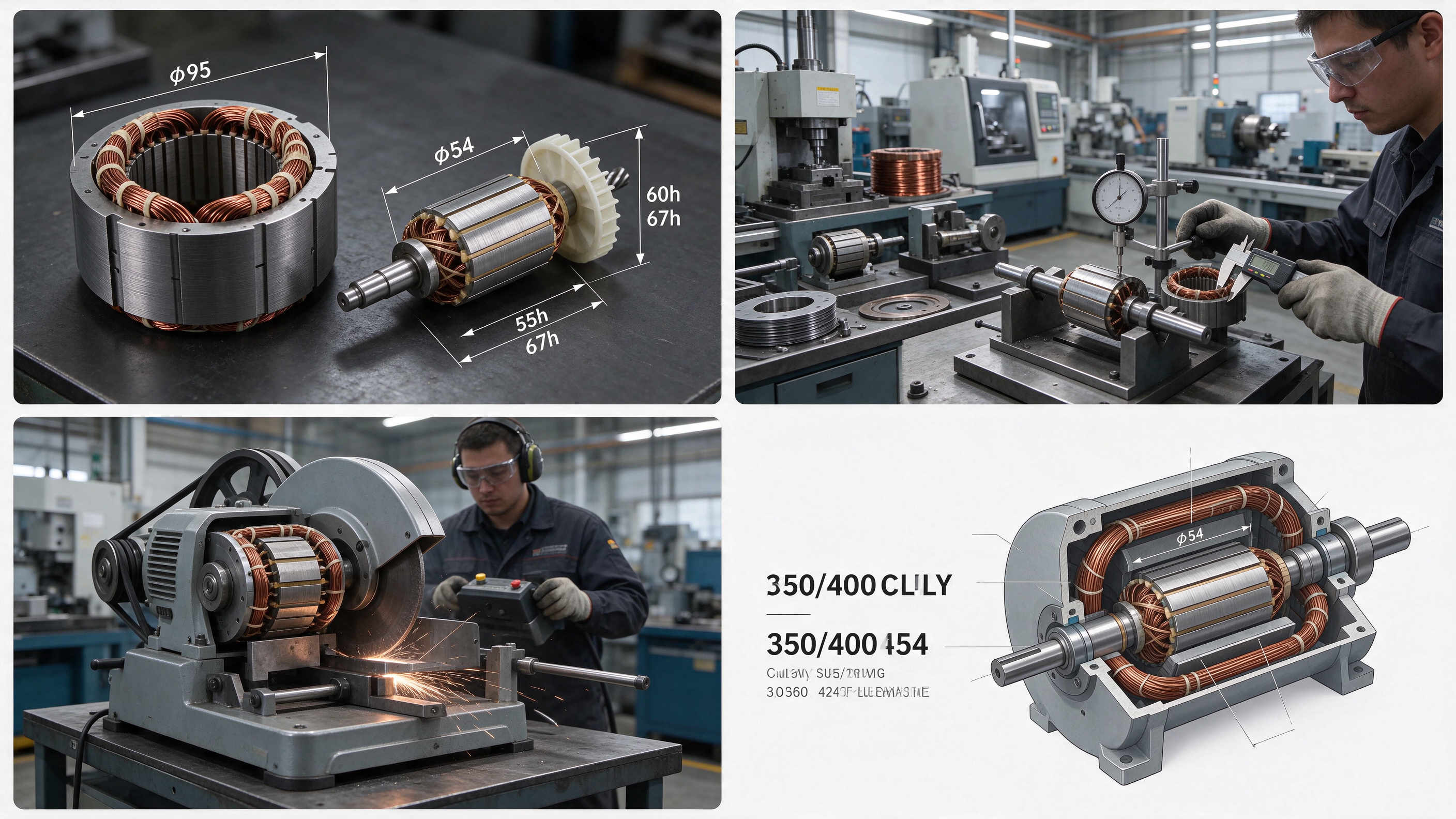
Developed for 350/400 cutting machine applications, this stator and rotor combination provides a practical replacement or production option for manufacturers, distributors, maintenance companies, and professional users. The stator has a φ95 specification, while the rotor is available in φ54 configurations with shaft heights of 55h, 60h, and 67h. This range allows buyers to select a suitable configuration according to motor structure, housing dimensions, shaft arrangement, and application requirements.
Unlike generic motor parts that may require extensive adjustment, a correctly manufactured stator and rotor set is intended to support better alignment, smoother rotation, and more consistent electrical performance. These characteristics are particularly important in cutting machines, where the motor is exposed to high starting loads, repeated acceleration and deceleration, vibration, dust, heat, and extended working cycles.
The 350/400 stator and rotor are manufactured by Yongkang Saima Machinery Technology Co., Ltd., also known as LESEN in its current brand development. The company specializes in power tool motors, mobile cutting machines, metal cutting machines, aluminum sawing machines, angle grinders, wall planing machines, motor accessories, and circular saw blades. Its manufacturing capabilities include research and development, casting, machining, assembly, testing, and customized production.
This article examines the product’s construction, performance advantages, manufacturing process, application value, purchasing considerations, and the company strengths that support consistent supply for wholesale and original equipment requirements.
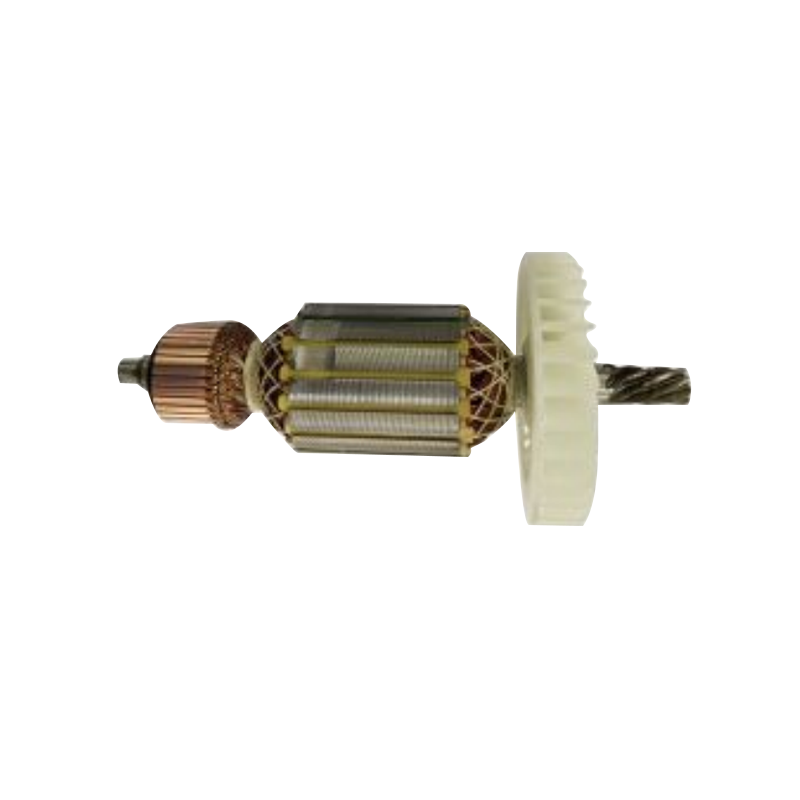
350/400 Motor Accessories φ95stator/φ54rotor
Product Overview
The 350/400 motor accessories φ95 stator/φ54 rotor are core motor components used to create and control electromagnetic rotation. The stator remains fixed inside the motor housing and generates the magnetic field required for operation. The rotor is mounted on the shaft and rotates within the stator. When the two components are correctly matched, electromagnetic force is converted into mechanical torque that drives the cutting machine or other connected equipment.
The product is intended for 350/400 cutting machine motor systems. Its configuration includes a φ95 stator and a φ54 rotor. The rotor specification is listed as Φ54x55h, Φ54x60h, or Φ54x67h, providing multiple height options for different motor assemblies. Buyers should confirm the required shaft height, winding arrangement, dimensions, mounting structure, and electrical parameters before placing an order.
| Product | 350/400 Motor Accessories |
| Primary Components | Stator and rotor |
| Stator Diameter | φ95 |
| Rotor Diameter | φ54 |
| Rotor Height Options | 55h, 60h, and 67h |
| Typical Application | 350/400 cutting machines and compatible power tool motors |
| Product Category | Cutting machine motor accessories |
| Manufacturing Type | Standard production and customized supply |
The product can be used for original motor production, replacement parts, repair operations, maintenance inventory, and the refurbishment of cutting machine motors. It is also suitable for distributors that supply compatible motor components to equipment manufacturers, service centers, and professional users.
Why the Stator and Rotor Matter in Cutting Machines
A cutting machine motor must produce sufficient torque while maintaining stable speed under changing loads. When a blade enters metal, aluminum, wood, or another workpiece, the motor experiences an immediate increase in resistance. A poorly matched or inaccurately manufactured stator and rotor may cause excessive vibration, unstable operation, heat generation, noise, or reduced cutting performance.
The stator and rotor form the electromagnetic heart of the motor. The stator’s magnetic circuit establishes the working field, while the rotor interacts with that field to generate rotation. Dimensional accuracy, lamination quality, winding consistency, shaft concentricity, and balance all influence the final result.
In a cutting machine, the motor also operates in a demanding environment. Fine dust may enter the ventilation system, the motor may be switched on and off repeatedly, and the tool may be used continuously for long production periods. The motor components must therefore support efficient energy conversion and withstand mechanical and thermal stress.
The 350/400 φ95 stator and φ54 rotor are designed to address these requirements through a combination of dimensional compatibility, robust materials, precision manufacturing, and application-specific configuration. The result is a component set intended to help maintain reliable motor operation across professional and industrial settings.
Key Advantages of the 350/400 φ95 Stator and φ54 Rotor
Improved Energy Efficiency
Efficient motor components help reduce unnecessary energy loss during operation. The stator and rotor are designed to support effective magnetic flux transfer and stable electromagnetic interaction. When the magnetic circuit is properly aligned and the rotor rotates with limited mechanical resistance, more of the supplied electrical energy can be converted into useful mechanical output.
Improved efficiency can benefit cutting machine users in several ways. The motor may require less energy to maintain its operating condition, heat accumulation can be reduced, and the equipment may deliver more consistent power during extended use. For factories and professional workshops, these benefits can contribute to lower operating costs and improved productivity.
Efficiency is not determined by the stator and rotor alone. It also depends on winding design, power supply, bearings, ventilation, blade selection, load conditions, and the complete motor architecture. However, high-quality electromagnetic components provide an essential foundation for achieving efficient performance.
Stable Torque Under Load
Cutting operations often involve variable resistance. The blade may encounter changes in material thickness, hardness, density, or feed speed. A motor with a stable electromagnetic system can respond more effectively to these changes, helping reduce sudden speed fluctuations.
The 350/400 stator and rotor are designed for motor systems that require dependable torque output. The optimized relationship between the φ95 stator and φ54 rotor supports consistent interaction between the magnetic field and rotating assembly. This is valuable when the cutting machine is used for repeated cuts, heavy-duty production, or demanding material processing.
Stable torque can also improve operator control. When the motor maintains a more consistent operating condition, the blade can move through the workpiece more smoothly. This may support cleaner cutting results, reduce unnecessary blade stress, and improve the overall working experience.
Reduced Vibration and Noise Potential
Vibration can result from multiple causes, including rotor imbalance, shaft runout, inaccurate assembly, bearing wear, blade imbalance, or incorrect installation. Precision manufacturing of the rotor and stator helps reduce one important group of potential causes.
A rotor produced to controlled dimensional tolerances can rotate more concentrically within the stator. Proper alignment supports smoother operation and reduces uneven electromagnetic forces. Similarly, a stator manufactured with consistent geometry can help maintain a more uniform magnetic field.
Lower vibration has practical benefits. It can reduce stress on bearings, housing components, fasteners, and connected cutting accessories. It may also support lower operating noise and improved durability. Although final noise and vibration levels depend on the complete machine, accurately manufactured motor accessories are an important part of the solution.
Durable Construction
Cutting machine motors may be exposed to repeated thermal cycles, mechanical shock, dust, and high rotational speed. The stator and rotor must therefore be manufactured from materials and processes that support long-term use.
The product is produced using high-grade steel and other suitable materials for motor construction. The rotor structure is designed to withstand rotational stress, while the stator is built to maintain mechanical and magnetic stability during operation. Proper material selection helps resist deformation, wear, and performance deterioration.
Durability is especially important for professional users who cannot afford frequent equipment downtime. A dependable replacement component can help extend the useful life of a motor and reduce the cost associated with repeated repairs or premature replacement of the complete machine.
Multiple Rotor Height Options
The Φ54 rotor is available in 55h, 60h, and 67h configurations. This selection provides greater flexibility for motor manufacturers and maintenance customers. Different motor housings, shaft arrangements, and output structures may require different rotor heights, so the availability of multiple options can simplify product matching.
Before ordering, buyers should compare the existing rotor with the required configuration. Important checks include rotor diameter, core length, shaft height, shaft diameter, commutator dimensions, keyway arrangement, winding characteristics, and overall shaft geometry. Technical confirmation helps prevent installation problems and ensures the replacement component is suitable for the intended motor.
Compact and Lightweight Motor Integration
A compact stator and rotor arrangement can support the design of smaller and more manageable motor assemblies. This is valuable for mobile cutting machines and handheld or semi-portable equipment, where excessive weight can reduce operator comfort and increase transportation difficulty.
Reducing unnecessary motor size and weight does not mean sacrificing strength. Instead, it requires careful coordination between magnetic performance, component dimensions, cooling, structural support, and output requirements. The 350/400 configuration is intended to provide a practical balance between power capability and motor packaging.
Resistance to Operational Wear
Motor components gradually experience wear due to rotation, heat, electrical loading, vibration, and environmental exposure. The stator and rotor are designed for continuous use in demanding equipment and may be treated or protected to improve resistance to common operating conditions.
Corrosion resistance can be particularly useful in workshops where moisture, cutting fluids, dust, or chemicals may be present. Protective measures help preserve component surfaces and reduce the risk of deterioration during storage, transport, and operation. The correct maintenance routine remains important, but durable component construction provides a stronger starting point.
Design and Engineering Considerations
Dimensional Compatibility
Dimensional compatibility is one of the most important factors when selecting a replacement stator and rotor. The φ95 stator and φ54 rotor are associated with 350/400 motor applications, but motor designs can differ between equipment models and production batches. A component should not be selected based only on a general product name.
Buyers should verify the motor housing, stator outer diameter, inner diameter, core length, mounting holes, rotor diameter, shaft length, shaft step positions, commutator position, and bearing seat dimensions. Accurate measurements or technical drawings allow the supplier to confirm whether the component is suitable.
For customized requirements, customers can provide samples, drawings, photographs with dimensions, or existing motor details. The manufacturer can then evaluate the required production process and determine whether a standard configuration or customized version is more appropriate.
Magnetic Circuit Performance
The quality of the magnetic circuit influences motor torque, efficiency, speed stability, and heat generation. The stator and rotor must be designed to work together rather than being treated as unrelated parts. The interaction of the core material, laminations, winding, air gap, and rotor structure determines the motor’s electromagnetic behavior.
Advanced production control helps maintain a consistent air gap and reduces irregular magnetic forces. The use of suitable magnetic materials can also support effective flux generation. These factors are important in cutting machines because the motor must deliver useful output without excessive energy loss.
Rotor Balance and Concentricity
High-speed rotating parts require balance and concentricity. Even a small imbalance can create vibration that becomes more noticeable as rotational speed increases. It may also place additional load on bearings and reduce the service life of connected components.
Machining accuracy, shaft alignment, pressing procedures, and dynamic balancing all contribute to rotor quality. A well-controlled manufacturing process helps ensure that the rotor maintains its intended position during operation. This supports smoother rotation and more predictable motor performance.
Thermal Management
Heat is generated by electrical resistance, magnetic loss, friction, and mechanical loading. If heat cannot be removed effectively, insulation, bearings, winding materials, and other components may deteriorate more quickly.
The stator and rotor are designed for integration into motor systems that include ventilation and heat dissipation measures. Their material selection and construction support reliable operation under normal working conditions. However, users should still avoid overloading the machine, blocking ventilation openings, using incorrect power supplies, or operating the tool beyond its rated duty cycle.
Manufacturing Process and Quality Control
Research and Development
Yongkang Saima Machinery Technology Co., Ltd. has developed from a small workshop into a professional manufacturer integrating research and development, production, and sales. Its development experience in power tool motors and cutting equipment provides practical insight into the operating requirements of motor accessories.
Research and development begins with understanding the complete application. For a cutting machine motor, the manufacturer considers power requirements, speed, torque, duty cycle, housing structure, blade load, cooling conditions, and customer expectations. This application-based approach helps ensure that motor accessories are developed for real equipment rather than only for isolated laboratory specifications.
The company maintains R&D capabilities for standard product improvement and customized production. Customers can discuss motor dimensions, electrical characteristics, shaft configurations, material requirements, packaging, and production quantities with the technical team.
Material Selection
Material selection directly affects the performance and durability of stators and rotors. Electrical steel, structural steel, copper, insulation materials, coatings, and shaft materials must be selected according to the design requirements.
For the stator and rotor, the core material must support suitable magnetic properties and mechanical stability. The shaft must withstand torque and rotational stress. Insulating materials must tolerate the expected temperature range and electrical conditions. Surface treatments should help protect the components during manufacturing, storage, and use.
Using appropriate materials also improves production consistency. Materials with stable properties are easier to process and inspect. They help reduce variation between batches and support more predictable motor assembly.
Precision Stamping and Lamination Processing
Motor cores are commonly formed from stacked laminations. The lamination shape influences the magnetic circuit, air gap, flux path, and overall motor behavior. Precision stamping allows the manufacturer to produce repeated shapes with controlled dimensions.
Consistent lamination geometry is important because uneven edges, distortion, or incorrect stacking can affect magnetic performance and mechanical alignment. Controlled stamping and stacking procedures help create a stable stator and rotor core structure.
The production process may include inspection of lamination dimensions, burr control, stacking height, alignment, and core integrity. These checks help ensure that the finished components meet the intended design requirements.
Winding and Insulation Control
The stator winding is responsible for creating the electromagnetic field. Winding quality affects electrical resistance, current distribution, heat generation, and magnetic balance. Consistent winding tension, positioning, insulation, and connection quality are therefore essential.
Insulation materials protect the winding from contact with the core and help prevent electrical breakdown. The winding process must ensure that conductors are placed securely and that the insulation system is not damaged during assembly.
Depending on the specific motor design, the manufacturer may conduct resistance checks, insulation checks, connection inspections, and other electrical tests. These procedures help identify defects before the component reaches final assembly.
Rotor Shaft Assembly
The rotor shaft must be assembled with accurate positioning and sufficient mechanical strength. Incorrect pressing force, shaft displacement, or poor concentricity can cause vibration and reduce motor life.
Controlled assembly equipment helps maintain the relationship between the rotor core, shaft, commutator, and other components. After assembly, the rotor may be inspected for runout, balance, shaft dimensions, and surface quality.
The availability of 55h, 60h, and 67h rotor configurations demonstrates the importance of shaft and core geometry in product selection. Each version should be confirmed against the target motor before production or installation.
Machining and Surface Treatment
Machining operations refine critical surfaces such as shaft seats, bearing locations, mounting areas, and connection points. The accuracy of these surfaces affects motor assembly and operating stability.
Surface treatment can help improve corrosion resistance and protect components during handling and storage. In environments where moisture or cutting fluids are present, appropriate protection may contribute to longer service life.
The manufacturer’s own foundry and processing capabilities support better control over important production stages. Internal capabilities can improve communication between design, production, quality inspection, and customer service teams.
Testing and Inspection
Testing is necessary to verify that the finished product is suitable for its intended use. Depending on the order and product configuration, inspection may include dimensional measurement, visual inspection, electrical testing, insulation testing, rotor balance checks, runout checks, and trial assembly.
Testing equipment and laboratory resources allow the manufacturer to evaluate product characteristics more systematically. Quality control is not limited to the final product; it can also be applied to incoming materials, intermediate processes, and finished motor assemblies.
A controlled testing system helps reduce the risk of inconsistent performance between batches. It also provides useful technical information when customers require customized designs or replacement parts for existing equipment.
Advantages Compared with Generic or Low-Control Alternatives
Better Application Matching
Generic motor accessories are often sold with limited technical information. A part may appear similar in diameter but differ in shaft height, core length, mounting structure, winding specification, or commutator position. These differences can lead to difficult installation or unreliable performance.
The 350/400 φ95 stator and φ54 rotor are identified by a defined application and detailed configuration. The available rotor heights provide a clearer starting point for technical confirmation. This helps buyers compare the product with their existing equipment more accurately.
More Consistent Production Support
Small-scale suppliers may rely heavily on outsourced production, making it difficult to control all stages of manufacturing. In contrast, a manufacturer with multiple production lines, processing resources, testing equipment, and an established R&D team can provide more coordinated quality management.
Yongkang Saima Machinery Technology Co., Ltd. operates an approximately 30,000-square-meter intelligent production factory and has six main production lines. These resources support higher production capacity and more organized order management, especially for wholesale customers and recurring orders.
Customization Capability
Cutting machine manufacturers may require nonstandard shaft lengths, winding parameters, mounting dimensions, materials, packaging, or branding. A supplier that only sells fixed products may not be able to support these requirements.
The company offers custom production capabilities and can communicate with customers about new product development. This is useful for original equipment manufacturers, distributors, and equipment brands that need motor accessories adapted to their own machine designs.
More Reliable Communication
Technical communication is important when buying motor components. Questions about drawings, samples, tolerances, power ratings, delivery schedules, packaging, and inspection requirements should be addressed before production.
With more than 20 years of industry experience and a 24-hour service response structure, the company is positioned to support international customers through product consultation, quotation, technical discussion, order coordination, and after-sales communication.
Production Capacity for Wholesale Buyers
Wholesale customers need more than a single successful sample. They require repeatable quality, stable supply, reasonable lead times, and the ability to handle increasing demand. A factory with multiple production lines and integrated manufacturing resources can provide a stronger supply foundation.
The company serves customers in more than 35 countries and regions. Its production experience across cutting machines, power tools, motor accessories, and related products supports the needs of importers, distributors, repair networks, and equipment manufacturers.
Applications of the Product
Mobile Cutting Machines
The primary application of the 350/400 stator and rotor is the motor system of mobile cutting machines. These machines are used in workshops, construction environments, fabrication facilities, hardware stores, and industrial production areas.
Mobile cutting machines require a balance between motor power, portability, durability, and operating comfort. The stator and rotor help the motor deliver stable rotation to the cutting blade while supporting repeated operation under changing loads.
Metal Cutting Equipment
Metal cutting machines place substantial demands on the motor because metal materials can create high resistance during cutting. The motor must maintain torque and manage heat while operating with a suitable blade and feed rate.
A durable stator and rotor can support the motor’s ability to operate under these conditions. Proper maintenance, correct blade selection, and adherence to rated capacity remain essential for safe and efficient cutting.
Aluminum Sawing Machines
Aluminum sawing machines require controlled speed and stable rotation to achieve clean cuts. The motor components must support smooth operation and reliable power transmission.
The compact configuration of the 350/400 motor accessories can be suitable for equipment where motor size and weight must be managed. The final suitability depends on the machine design, blade specification, and required operating speed.
Power Tools
Stator and rotor assemblies are also used in power tools such as grinders, drills, saws, and other electrically driven equipment. These tools often experience rapid start-stop cycles, high rotational speed, and variable loads.
The product’s precision manufacturing and durable construction can support consistent operation in professional power tool applications. Buyers should verify that the electrical and mechanical characteristics match the target tool before use.
Industrial Machinery
Similar motor components may be used in conveyors, pumps, fans, compact processing equipment, and other industrial systems. These applications benefit from reliable motor operation and long service intervals.
The 350/400 configuration may be considered where the motor’s dimensions, output, and duty cycle correspond to the equipment requirements. For industrial installations, buyers should also consider environmental protection, cooling, duty rating, maintenance access, and spare-part planning.
Automated Systems
Automation equipment depends on predictable motor behavior. Conveyors, positioning systems, feeders, and small robotic mechanisms require components that support repeatable movement and controlled operation.
Precision stator and rotor manufacturing can help reduce unwanted vibration and variation. This can be valuable in automated processes where inconsistent movement may affect productivity or product quality.
HVAC and General Equipment
Motors in fans, pumps, air-handling systems, and other equipment may also use compatible stator and rotor components. These applications often operate for long periods, making efficiency and durability important considerations.
Before selecting the product for HVAC or general equipment, the buyer should confirm the motor’s speed, voltage, current, torque, mounting arrangement, and duty cycle. Compatibility should always be evaluated based on the complete motor design.
Installation and Maintenance Recommendations
Confirm Specifications Before Installation
Before installing a replacement stator or rotor, compare the new component with the original part or approved drawing. Check all critical dimensions, including diameter, core height, shaft length, bearing seats, commutator position, mounting points, and electrical connections.
Do not force a component into place if the fit is incorrect. Excessive pressing force or unauthorized machining may damage the core, shaft, winding, insulation, or housing. If uncertainty exists, consult the supplier’s technical team before assembly.
Keep Components Clean
Dust and metal particles can affect motor performance. During installation, keep the stator, rotor, bearings, commutator, and housing clean. Avoid allowing abrasive particles to enter the air gap or bearing area.
Clean assembly conditions help preserve the designed clearance and reduce the risk of early wear. The motor should also be protected from moisture during storage and installation.
Inspect Bearings and Related Parts
A new rotor cannot compensate for worn or damaged bearings. Before assembly, inspect the bearings, seals, housing, cooling fan, electrical connections, and blade drive components. Replace damaged supporting parts where necessary.
Proper bearing condition helps the rotor maintain alignment and reduces mechanical resistance. It also supports lower vibration and longer service life.
Avoid Overloading
Even a well-manufactured motor accessory can be damaged by excessive loading. Operators should use the machine according to its rated capacity, select the correct blade, maintain a suitable feed speed, and avoid forcing the blade through material.
Overloading can increase current draw and heat generation. It may damage the winding, insulation, commutator, bearings, and other motor components. Good operating practices are therefore essential to achieving the expected service life.
Maintain Ventilation
Cooling passages and ventilation openings should remain clear. Dust accumulation can restrict airflow and cause excessive temperature rise. Periodic cleaning is recommended for machines operating in dusty cutting environments.
Users should also monitor unusual heat, odor, noise, vibration, sparking, or speed fluctuation. These signs may indicate a problem that should be investigated before continued operation.
Purchasing Guidance for Distributors and Manufacturers
When purchasing the 350/400 φ95 stator and φ54 rotor, buyers should provide as much technical information as possible. Useful information includes the motor model, machine model, original component photographs, dimensions, drawings, required quantity, voltage, frequency, speed, power, and application environment.
Sample approval is recommended for new projects or large orders. A sample allows the customer to verify fit, assembly, motor behavior, and compatibility before mass production. For replacement programs, side-by-side measurement of the original and sample components can reduce risk.
Buyers should also confirm packaging requirements. Motor accessories should be protected against impact, moisture, abrasion, and deformation during transport. Export orders may require individual packaging, reinforced cartons, pallets, labeling, barcodes, or customer-specific documentation.
For recurring orders, customers should discuss quality standards, inspection procedures, production schedules, spare-part planning, and acceptable tolerances. Clear agreement at the beginning of the supplier relationship helps maintain consistency over time.
Company Manufacturing Strengths
Yongkang Saima Machinery Technology Co., Ltd. was established in 2005 in Yongkang, Zhejiang, a region recognized for hardware and power tool manufacturing. The company has developed from imitation and small-scale workshop production toward innovation, organized manufacturing, and independent product development.
The LESEN brand was created in 2015 after years of industrial development. Today, the company integrates research and development, production, sales, technical support, and customer service. Its product portfolio includes mobile cutting machines, metal cutting machines, cut-off machines, aluminum sawing machines, angle grinders, wall planing machines, cutting machine motor accessories, and circular saw blades.
The factory covers approximately 30,000 square meters and operates six main production lines. Its capabilities include a strong R&D team, an own foundry, machining facilities, advanced testing equipment, laboratory resources, and custom production support.
These capabilities provide several benefits to buyers. Product development can be coordinated with manufacturing. Technical changes can be communicated more efficiently. Production capacity can support both standard products and customized projects. Quality checks can be applied at different stages rather than only after final assembly.
The company also emphasizes competitive costs, reliable quality, production capacity, customization, and on-time delivery. Its trade coverage extends to more than 35 countries and regions, demonstrating experience with international customer requirements and export orders.
For buyers of motor accessories, supplier capability is as important as the individual component. A reliable factory should be able to answer technical questions, provide samples, maintain production consistency, manage packaging, and respond to quality concerns. The company’s integrated structure is intended to support these requirements.
Frequently Asked Questions
What is included in the 350/400 motor accessory product?
The product refers to a stator and rotor combination for 350/400 motor applications. The stator specification is φ95, and the rotor specification is φ54. Rotor height options include 55h, 60h, and 67h. Buyers should confirm whether they require a complete set or a specific component before ordering.
What machines can use the φ95 stator and φ54 rotor?
The primary application is 350/400 cutting machine motors. Depending on dimensional and electrical compatibility, similar components may also be used in power tools, industrial machinery, fans, pumps, automated equipment, and other motor systems. Compatibility must be confirmed through technical specifications rather than product appearance alone.
Are customized versions available?
Customized production is available for suitable projects. Customers may discuss shaft dimensions, rotor height, winding requirements, mounting details, materials, packaging, and other specifications with the manufacturer. Drawings, samples, and detailed measurements can help the technical team evaluate the request.
How can I confirm whether the rotor will fit my motor?
Compare the original rotor with the proposed replacement. Check the rotor diameter, core length, shaft height, shaft diameter, bearing seats, commutator dimensions, keyway, and overall shaft arrangement. Providing photographs, drawings, or measured samples to the supplier is recommended before purchase.
What are the main benefits of using a matched stator and rotor?
A matched set can support better electromagnetic interaction, alignment, torque stability, and smoother operation. It may also reduce vibration and energy loss compared with poorly matched or inaccurately manufactured components. The final result depends on the complete motor design and correct assembly.
Is the product suitable for heavy-duty use?
The components are designed for high-performance motor systems and demanding applications such as cutting machines and power tools. Their suitability for a specific heavy-duty application depends on the motor rating, operating cycle, cooling method, load, installation quality, and maintenance program.
Can the company supply wholesale quantities?
Yes. The company has multiple production lines, an approximately 30,000-square-meter factory, and experience serving international customers. Wholesale buyers should provide estimated annual demand, order quantity, target specifications, packaging requirements, and delivery expectations for a detailed quotation.
What quality checks should buyers request?
Depending on the project, buyers may request dimensional inspection, electrical testing, insulation testing, rotor balance verification, shaft runout inspection, visual inspection, sample assembly, and performance testing. The exact inspection plan should be agreed upon before production.
How should the components be stored?
Store the stator and rotor in a dry, clean environment protected from moisture, impact, dust, and corrosive substances. Keep the components in suitable packaging and avoid placing heavy objects on them. Long-term storage should include periodic inspection for corrosion or packaging damage.
What information should be included in an inquiry?
An inquiry should include the motor or machine model, required component, dimensions, rotor height, quantity, application, electrical requirements, sample or drawing availability, packaging needs, destination country, and target delivery schedule. Complete information helps the supplier provide a faster and more accurate response.
Conclusion
The 350/400 motor accessories φ95 stator and φ54 rotor are designed for cutting machine motors that require stable power, durable construction, and accurate component matching. Their key advantages include efficient electromagnetic operation, dependable torque under load, multiple rotor height options, compact integration, reduced vibration potential, and resistance to demanding working conditions.
The product is supported by a manufacturing structure that includes research and development, material control, core processing, winding, machining, assembly, testing, and customized production. Yongkang Saima Machinery Technology Co., Ltd., operating with the LESEN brand, combines more than 20 years of industry experience with a 30,000-square-meter intelligent factory, six production lines, internal processing capabilities, advanced testing equipment, and international service experience.
For cutting machine manufacturers, wholesalers, distributors, and maintenance providers, the product offers a practical option for original equipment production and motor replacement. Correct technical confirmation remains essential. Buyers should verify all mechanical and electrical parameters, request samples where necessary, and establish clear inspection and packaging requirements before placing a production order.
When supported by accurate installation, suitable operating conditions, regular maintenance, and correct load management, the 350/400 φ95 stator and φ54 rotor can contribute to reliable motor performance and longer equipment service life across professional, industrial, and power tool applications.
References
1. General principles of electric motor design, including stator and rotor interaction, magnetic circuits, torque production, and motor efficiency.
2. Industrial guidance on electrical steel laminations, core stacking, insulation systems, winding practices, and motor thermal management.
3. Manufacturing quality control practices for precision shafts, rotating assemblies, dynamic balancing, dimensional inspection, and motor component testing.
4. Product information supplied for the 350/400 motor accessories φ95 stator and φ54 rotor, including Φ54x55h, Φ54x60h, and Φ54x67h rotor configurations.
5. Company manufacturing information supplied by Yongkang Saima Machinery Technology Co., Ltd., including product categories, production capabilities, factory resources, R&D activities, and international service coverage.