English
 عربى

Motor performance depends on much more than the external housing, switch, or power supply. At the center of every electric motor, the stator and rotor work together to convert electrical energy into controlled mechanical motion. Their dimensional accuracy, material quality, thermal behavior, balance, and compatibility determine how smoothly and reliably the motor performs. For manufacturers of cutting machines, power tools, industrial equipment, and other compact motor systems, selecting the correct internal motor accessories is therefore a critical engineering decision.
The 0810 motor accessory set, identified by a φ72 stator and a φ41.2 rotor, is designed for applications that require a practical balance of efficiency, durability, compactness, and consistent operation. The supplied product information specifies the stator as Φ72x45h, while the product description identifies the rotor diameter as φ41.2. Together, these components form a carefully matched motor core assembly intended for integration into cutting-machine motors and other electrical equipment.
This article examines the construction, performance advantages, application potential, quality considerations, and manufacturing capabilities associated with the 0810 φ72 stator and φ41.2 rotor. It also explains why buyers should evaluate the complete production capability behind a motor accessory rather than comparing dimensions and prices alone.
Product Overview
The 0810 motor accessory is a stator and rotor combination for compact and medium-duty electric motor systems. The stator has a nominal outside diameter of 72 millimeters and a stated height or stack dimension of 45 millimeters. The matching rotor has a nominal diameter of 41.2 millimeters. These dimensions provide a defined electromagnetic structure that can be adapted to suitable motor housings, shafts, windings, bearings, and electrical configurations.
The stator remains stationary inside the motor housing. It carries the winding system and establishes the magnetic field required for rotation. The rotor is the rotating element positioned inside the stator. When the motor is energized, electromagnetic interaction between the stator field and the rotor produces torque. Because the working air gap between these components is small and highly influential, the dimensional relationship between the φ72 stator and φ41.2 rotor is particularly important.
A correctly matched stator and rotor can help a motor achieve stable rotation, controlled mechanical output, and lower internal losses. By contrast, inaccurate dimensions, poor concentricity, weak laminations, unbalanced rotating parts, or unsuitable materials may result in excess noise, vibration, heat, and premature wear. The 0810 design addresses these concerns through precision-oriented dimensions and a compact form intended for integration into practical tool and machinery platforms.
| Product Item | Specification |
| Model | 0810 |
| Product Type | Motor stator and rotor accessory assembly |
| Stator Diameter | φ72 millimeters |
| Stator Dimension | Φ72x45h |
| Rotor Diameter | φ41.2 millimeters |
| Primary Product Category | Cutting machine motor accessories |
| Potential Application Areas | Cutting machines, power tools, appliances, industrial equipment, and customized motor assemblies |
Why Stator and Rotor Quality Matters
In a motor, the stator and rotor are not simply interchangeable metal parts. They are functional electromagnetic components that must operate within carefully controlled mechanical and electrical conditions. The stator must support the winding system and maintain its geometry under heat and vibration. The rotor must rotate concentrically, transfer torque through the shaft, and maintain reliable performance over repeated operating cycles.
The air gap between the stator and rotor is one of the most sensitive areas in the assembly. If the gap is too large, magnetic coupling may weaken and motor efficiency may decline. If the gap is too small or inconsistent, the rotor may rub against the stator under vibration, thermal expansion, or bearing movement. Consistent dimensions and appropriate processing are therefore essential to achieving stable operation.
Material selection is equally important. Electrical steel or other suitable magnetic materials can reduce energy loss caused by eddy currents and hysteresis. Copper or an appropriate conductive winding material supports current flow in the stator. The rotor structure must provide mechanical strength, dimensional stability, and sufficient resistance to centrifugal forces. When these elements are produced and assembled correctly, the finished motor can deliver more predictable performance and a longer working life.
For cutting machines, these requirements become even more demanding. A cutting machine motor may experience high rotational speeds, repeated starts and stops, changing loads, dust, vibration, and extended periods of operation. A motor accessory that performs adequately in a light-duty application may not provide the same reliability in a demanding cutting environment. The 0810 assembly is therefore valuable as a specialized component option for manufacturers seeking a compact and carefully defined motor core.
Precision Dimensions and Motor Compatibility
The φ72 stator and φ41.2 rotor dimensions establish the basic physical relationship of the motor core. The stated Φ72x45h stator specification provides manufacturers with a clear reference for housing design, winding arrangement, mounting structure, and production planning. The φ41.2 rotor dimension helps define the internal rotating assembly and its relationship to the shaft, bearings, commutator, fan, or other motor elements, depending on the final motor design.
Dimensional consistency supports compatibility in several ways. First, it allows the customer’s engineering team to evaluate whether the accessory can fit within an existing housing or whether a new housing should be developed. Second, it assists in calculating the air gap and determining winding and magnetic circuit requirements. Third, it simplifies repeat production because the same component dimensions can be used as a stable basis for assembly tooling and quality inspection.
Precision does not mean that every customer must use the accessory in exactly the same final motor. Motor manufacturers may require different shaft lengths, winding arrangements, voltage configurations, insulation systems, connection methods, or performance targets. A well-organized manufacturer can use the standard 0810 dimensions as a starting point while discussing possible customization for a specific application.
Customers should confirm all interface requirements before ordering. Important details may include the complete rotor length, shaft diameter and extension, keyway or flat design, bearing seats, stator mounting features, winding specifications, insulation class, rated voltage, speed, torque, duty cycle, and cooling arrangement. The supplied information confirms the model and core dimensions, but the complete motor design must be finalized according to the intended application.
Efficiency Benefits
One of the main advantages of a properly designed stator and rotor is the potential to reduce unnecessary energy loss. Motor efficiency is influenced by winding resistance, magnetic material, air-gap geometry, mechanical friction, rotor balance, ventilation, and load matching. The φ72 stator and φ41.2 rotor are engineered as a coordinated pair so that the electromagnetic circuit can operate with a controlled relationship between the stationary and rotating elements.
When the air gap is consistent and the magnetic circuit is correctly designed, the motor can convert a greater proportion of electrical input into useful mechanical output. Lower internal losses can reduce the amount of heat generated during operation. This may help improve working stability, particularly when the motor is used for longer periods or under variable loads.
Efficiency also affects operating cost. A motor that wastes less energy may require less electrical input to produce a comparable output. For professional users operating multiple cutting machines or power tools, even a modest improvement in energy behavior can become meaningful over the service life of the equipment. Lower heat generation can also reduce stress on insulation, bearings, windings, and surrounding components.
It is important to recognize that stator and rotor efficiency cannot be evaluated in isolation. Final results depend on the complete motor, including winding design, magnets or rotor conductors, control method, bearings, fan, housing, power supply, and working load. Nevertheless, a precisely produced motor core creates a strong foundation for efficient final-motor engineering.
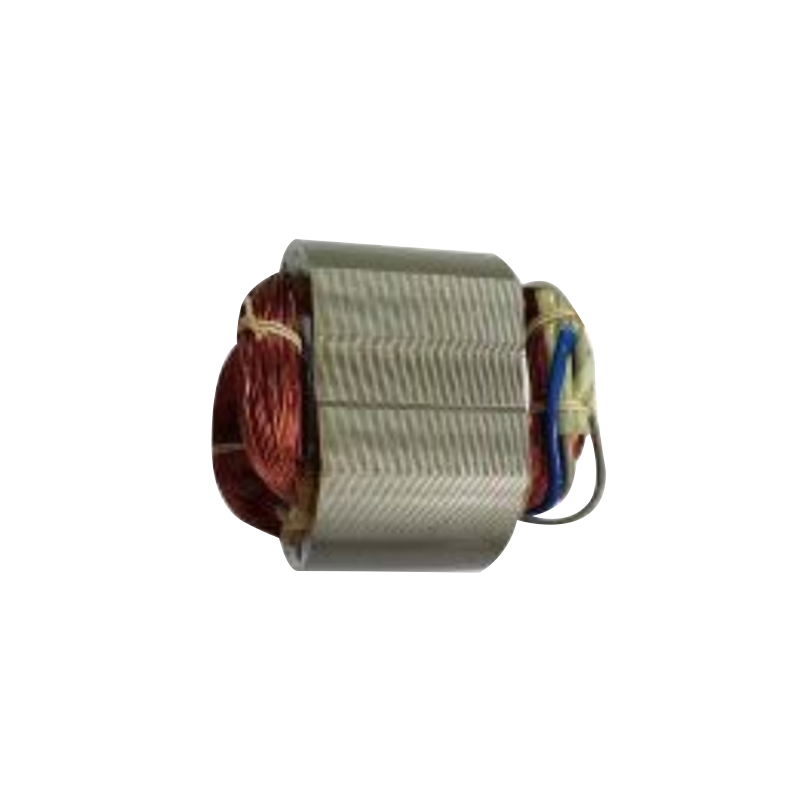
0810 Motor Accessories φ72stator/φ41.2rotor
Durability Under Demanding Conditions
Cutting machines and power tools are frequently exposed to conditions that place significant stress on their motors. High-speed rotation creates centrifugal forces. Abrasive dust may enter through ventilation paths. Repeated impact or cutting resistance can create torque fluctuations. Long operating periods raise internal temperature. Transportation and daily handling can add additional shock and vibration.
The 0810 motor accessory is designed around durable stator and rotor construction intended for prolonged service. The use of suitable steel components, conductive winding materials, and controlled processing supports mechanical and electrical stability. A robust rotor must remain dimensionally reliable while rotating, and the stator must maintain its structural integrity while carrying current and experiencing thermal cycles.
Durability is not limited to resistance against sudden failure. It also includes the ability to maintain acceptable performance over time. A motor core that gradually develops excessive vibration, loses efficiency, or experiences insulation stress may create higher maintenance costs even if it continues to operate. Stable manufacturing and appropriate material selection help reduce the risk of these gradual performance problems.
The actual service life will depend on the final motor design and operating environment. Proper bearing selection, balanced assembly, adequate cooling, correct voltage, suitable overload protection, and regular maintenance all contribute to durability. The stator and rotor should be treated as part of a complete engineered system rather than as isolated replacement pieces.
Thermal Management and Heat Dissipation
Heat is a major factor in motor reliability. Electrical resistance in the windings, magnetic losses in the core, friction in the bearings, and air resistance during rotation all produce heat. If this heat cannot be removed effectively, the motor temperature may rise beyond the safe operating range of its insulation, lubricant, bearings, or structural materials.
The compact geometry of the 0810 stator and rotor can support integration into motor housings with an appropriate cooling strategy. The stator and rotor dimensions allow engineers to plan the available internal space for ventilation channels, cooling fans, housing fins, and heat-transfer surfaces. Efficient heat dissipation helps the motor maintain more consistent performance during extended use.
A suitable heat-management design may include airflow through the housing, external cooling ribs, a rotor-mounted fan, thermal protection, or an application-specific ventilation system. The correct approach depends on the final motor speed, power, duty cycle, environmental conditions, and enclosure design. The motor accessory provides a precision core, while the complete cooling system must be developed around the customer’s operating requirements.
Improved thermal behavior can offer several benefits. It may help reduce insulation aging, protect winding connections, minimize bearing stress, and reduce the likelihood of thermal shutdown. Stable temperature also supports more consistent torque and speed characteristics. For cutting equipment used in workshops, construction environments, and industrial facilities, thermal control is especially important because the motor may be operated repeatedly throughout the day.
Vibration Resistance and Rotational Stability
Vibration affects both motor performance and the service life of connected machinery. Excessive vibration can loosen fasteners, damage bearings, increase noise, disturb cutting accuracy, and transfer stress to the tool housing. It may originate from rotor imbalance, misalignment, uneven air gaps, bearing problems, electromagnetic forces, or an unsuitable connection between the motor and driven equipment.
A precisely manufactured rotor with appropriate balance is essential for smooth rotation. The relationship between the rotor diameter and stator bore must remain consistent around the complete circumference. When the rotor is correctly centered and supported, the motor can operate with reduced mechanical disturbance. The stator must also be held securely so that it does not shift under electromagnetic forces or vibration.
The 0810 φ72 stator and φ41.2 rotor provide a defined basis for developing a balanced assembly. Customers can combine the motor core with suitable bearings, shafts, housings, and mounting structures to achieve the vibration level required by their equipment. In high-speed cutting applications, the complete assembly should be dynamically evaluated rather than relying only on static dimensional inspection.
Lower vibration improves the user experience as well as the product’s technical performance. Operators may experience less hand fatigue when using a portable tool. A fixed cutting machine may generate less noise and place lower stress on its frame. In both cases, smoother operation can support more consistent cutting results and longer component life.
Compact and Lightweight Integration
Space and weight are important considerations in modern power tools and machinery. A motor that is unnecessarily large may make a tool difficult to handle, increase shipping costs, and require a larger housing. A motor that is too heavy may reduce portability or increase the load on the equipment frame. The compact dimensions of the 0810 motor accessory can help designers develop a more efficient internal layout.
The φ72 stator with a 45-millimeter height provides a clear envelope for the electromagnetic core. The φ41.2 rotor provides a compact rotating structure that can be combined with an appropriate shaft and bearing arrangement. This dimensional profile may be suitable for designs where the available motor space is limited but reliable mechanical output is still required.
Compact integration can create additional design freedom. Engineers may reserve more space for electronic controls, thermal protection, dust management, or ergonomic housing features. In portable cutting machines, reduced motor size may contribute to better balance between the handle and cutting head. In fixed industrial equipment, it may enable a smaller machine footprint or a more flexible mounting arrangement.
Weight reduction must always be considered together with strength, thermal performance, and power requirements. Removing material without appropriate engineering can create unwanted heat or structural weakness. The advantage of a purpose-designed motor accessory is that its dimensions can be considered as part of a complete electromagnetic and mechanical design rather than treated as an arbitrary reduction in size.
Applications in Cutting Machines
The most direct application for this product is the motor system of a cutting machine. Cutting machines may be used for metal, aluminum, wood, plastic, stone, or other materials, depending on the blade, speed, power, and machine construction. Their motors must provide dependable rotation while responding to changing resistance from the workpiece.
In metal cutting equipment, the motor may be exposed to high load variation and intense operating cycles. The stator and rotor must support a stable power supply to the cutting system while managing heat generated during extended use. In aluminum sawing machines, accurate and smooth rotation can contribute to cleaner cuts and improved blade control. In portable cut-off machines, compactness and vibration behavior are particularly important because the operator directly handles the tool.
The 0810 accessory can also be considered for replacement-motor production, spare-parts programs, and new equipment development. A manufacturer may use the assembly in a standard motor platform or adapt it to a customer-specific design. Before mass production, the complete motor should be tested for no-load speed, loaded torque, temperature rise, sound, vibration, current consumption, insulation performance, and endurance under representative working conditions.
Because cutting applications vary widely, buyers should communicate the machine type and intended cutting material to the motor manufacturer. The required performance may differ between a light-duty workshop saw and a heavy-duty industrial cut-off machine. Information about blade diameter, target speed, rated power, duty cycle, supply voltage, and load profile will help engineers select or customize the correct motor configuration.
Applications in Power Tools
The accessory may also support the development of other power-tool motors. Angle grinders, wall planing machines, polishing tools, compact saws, and specialized processing tools all require motors with a suitable combination of speed, torque, weight, and durability. The correct stator and rotor geometry provides a foundation for these performance characteristics.
For handheld equipment, vibration and balance are critical. The operator may use the tool for long periods, and excessive vibration can cause discomfort or reduce control. A well-balanced rotor, a rigid stator mounting system, and suitable bearings can improve the overall handling of the finished tool. Compact dimensions can also make it easier to position the center of gravity near the operator’s preferred grip.
For stationary tools, reliability and thermal performance may have greater priority. A motor installed in a workshop machine could operate through multiple production cycles, making heat management and winding protection essential. The same core accessory may be configured differently depending on whether the target product emphasizes portability, continuous operation, high starting torque, high speed, or low noise.
Using a defined motor accessory can shorten the early stages of product development. Instead of creating every component from the beginning, engineers can evaluate a known stator and rotor dimension, then design the surrounding motor structure around it. This approach may reduce development risk and support more consistent production planning.
Broader Industrial and Equipment Uses
Small and medium-sized electric motors are used throughout industrial machinery. They may drive fans, pumps, conveyors, compact processing tools, actuators, ventilation systems, and auxiliary mechanisms. In these applications, the motor may be expected to run continuously, start frequently, or operate under changing loads.
The 0810 assembly may be suitable for selected industrial motor platforms where its dimensions and performance requirements match the application. Its precision-oriented design can support repeatable integration across production batches. Its compact form may also be useful where equipment designers must fit a motor into a restricted mechanical enclosure.
Household appliances represent another potential application area. Appliances such as ventilation equipment, compact pumps, air-moving systems, washing-machine mechanisms, and other motorized products require reliable and cost-effective motor components. The final specification must be matched to the appliance’s noise, speed, safety, insulation, and duty requirements.
Automotive and renewable-energy applications may also use specialized motor components, although such applications require detailed validation. Vehicle systems and energy equipment can experience wide temperature ranges, vibration, moisture, and strict reliability expectations. The 0810 stator and rotor should only be applied in these environments after the complete motor has passed the customer’s required validation program.
Advantages Compared with Generic Motor Components
One advantage of using a defined model such as the 0810 assembly is greater clarity during design and purchasing. Generic components may be described with incomplete dimensions or inconsistent tolerances, making it difficult to confirm compatibility. A clearly identified model with a stated stator size and rotor diameter gives engineering teams a more reliable starting point.
Another advantage is the possibility of coordinated production. When the stator and rotor are developed as a matched set, the manufacturer can consider their dimensional relationship, electromagnetic performance, and assembly requirements together. Purchasing separate components from unrelated suppliers may create problems involving air-gap variation, shaft alignment, material differences, or inconsistent quality standards.
Production consistency is also important for after-sales support. If replacement parts are manufactured according to a stable model specification, distributors and equipment manufacturers can manage inventory more effectively. Customers can receive components with a more predictable fit, reducing the time required for modification or troubleshooting.
The product’s suitability for customization is another potential advantage. A capable manufacturer may be able to discuss changes to winding, shaft configuration, insulation, connection method, or other interfaces while preserving the main design concept. This can be more practical than adapting a completely unrelated off-the-shelf motor component.
Price should not be the only basis for comparison. A lower-cost component may generate additional expenses if it produces higher failure rates, inconsistent performance, difficult assembly, or delayed delivery. Buyers should compare dimensional control, material traceability, testing capability, production capacity, customization support, and service response alongside unit price.
Advanced Manufacturing Approach
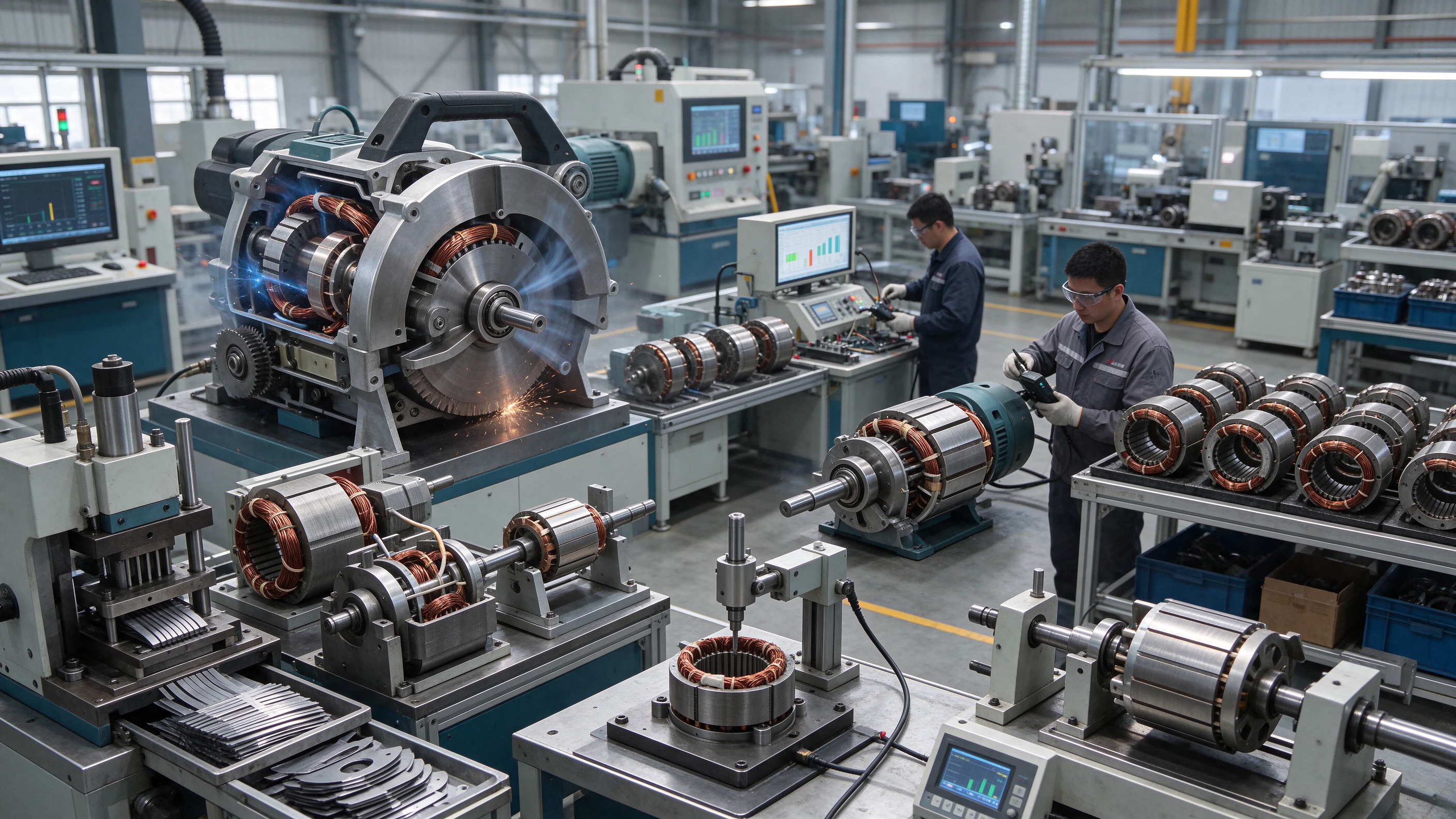
The performance of a motor accessory depends heavily on the manufacturing process used to produce it. A strong motor manufacturer must control multiple stages, including material preparation, stamping or forming, lamination assembly, winding, rotor processing, shaft integration, balancing, inspection, and final testing. Each stage influences the behavior of the completed motor.
The manufacturing organization behind this product operates as a professional tool manufacturing company integrating research and development, production, and sales. Its capabilities include six main production lines, research and development resources, production and laboratory equipment, a foundry and processing plant, and testing facilities. These resources support a more coordinated approach to motor and power-tool manufacturing than simple trading or assembly operations.
A production facility with its own processing capability can respond more effectively to engineering changes. It may be able to adjust tooling, modify production parameters, and coordinate quality checks without depending entirely on unrelated subcontractors. This can be particularly useful for customers requiring customized motor accessories or repeat orders with stable specifications.
The company reports more than 20 years of industry experience and a 30,000-square-meter intelligent production factory. It also describes a history of development from imitation to innovation and from a small workshop to larger-scale production. This experience can contribute to better process understanding, more effective production scheduling, and improved communication between design and manufacturing teams.
Research, Development, and Customization
Motor accessories are often integrated into products with different power ratings, housings, control systems, and working conditions. For this reason, customization support is an important supplier capability. A customer may need a particular shaft interface, winding arrangement, speed, insulation system, connector, or mounting structure even when the basic stator and rotor dimensions remain similar.
The manufacturer’s research and development capabilities allow product discussions to move beyond a standard catalog description. Engineers can review the customer’s application, identify the required operating parameters, and recommend a suitable configuration. This process may involve reviewing drawings, load data, assembly constraints, target quantities, and testing requirements.
Effective customization begins with accurate technical communication. Customers should provide dimensional drawings, motor performance targets, electrical information, expected duty cycle, environmental conditions, and applicable quality requirements. The supplier can then evaluate tooling, material, process, testing, and delivery implications before confirming a quotation or production plan.
Customization may provide benefits in several areas. A shaft can be adapted to the driven mechanism. The winding can be designed for a particular voltage or speed range. Insulation and protection can be selected for the expected temperature. The external mounting structure can be coordinated with the machine housing. These changes help the final motor fit the application more effectively than a generic component.
Process Control and Quality Management
Reliable motor accessories require quality control throughout production rather than inspection only at the end. Incoming materials should be checked for dimensions and suitability. Stator laminations should be evaluated for shape, stacking, and assembly consistency. Rotor components should be inspected for concentricity, shaft fit, and balance. Winding and insulation processes should be controlled to reduce electrical defects.
Dimensional inspection is especially important for the 0810 product because the stated φ72 stator and φ41.2 rotor must work together within a controlled mechanical relationship. Measurements may include outside diameter, inside diameter, stack height, shaft dimensions, bearing seats, runout, and alignment. The exact inspection plan should reflect the final motor design and customer drawings.
Electrical testing may include resistance checks, insulation resistance, dielectric strength, no-load current, no-load speed, and performance under load. Mechanical testing may include vibration, noise, balance, temperature rise, and endurance. Not every test applies in the same way to every unfinished accessory, so the final inspection plan should be agreed upon according to whether the customer is purchasing individual components, a matched core, or a complete motor.
Laboratory and testing equipment provide a basis for identifying process variation before products are shipped. This supports continuous improvement and helps the manufacturer compare production results against internal standards or customer requirements. A supplier that can discuss test methods clearly is generally better positioned to support technically demanding buyers.
Production Capacity and Delivery Support
For equipment manufacturers, delivery reliability can be as important as product quality. A delay in motor accessories may stop assembly lines, postpone customer shipments, or create shortages in after-sales inventory. Production capacity, multiple production lines, material planning, and clear communication all contribute to dependable delivery.
The manufacturer states that it has several production lines and effective productivity supported by an intelligent factory. This structure can help separate or coordinate different product categories, including cutting machines, tool motors, motor accessories, and circular saw blades. A broader production system may also support better resource planning when demand changes between product groups.
Customers should discuss forecast quantities, sample requirements, tooling lead times, packaging, inspection documentation, and delivery schedules at the beginning of the project. For repeat orders, a rolling forecast can help the supplier plan materials and capacity. For customized products, approving technical drawings and samples early can reduce the risk of later changes.
On-time delivery is strengthened when technical, commercial, and production teams communicate through a clear process. The supplier’s stated 24-hour service response and international trade coverage may be useful to customers working across time zones, although the exact response and delivery arrangement should be confirmed for each order.
How to Evaluate the Product Before Ordering
A professional buyer should begin by defining the intended application. The required information may include the machine type, material being processed, rated power, rated speed, torque, duty cycle, voltage, frequency, control method, housing dimensions, shaft requirements, cooling conditions, and expected service environment.
The next step is to confirm the interface dimensions. The supplied product information identifies the model as 0810, the stator as Φ72x45h, and the rotor diameter as φ41.2. Buyers should request a complete technical drawing if they need additional information such as bore size, stack tolerances, shaft length, shaft diameter, keyway, bearing seat, winding details, or connection design.
Samples should be tested in the customer’s own motor housing whenever possible. A laboratory test using a standalone component may not represent the final application. Testing in the intended assembly allows the customer to evaluate air-gap behavior, thermal performance, sound, vibration, current, torque, speed, and compatibility with the actual control system.
Quality documentation should also be discussed. Depending on the project, buyers may request material information, dimensional inspection reports, electrical test records, sample approval documents, production inspection procedures, packaging standards, and traceability information. The required documents should be agreed upon before mass production begins.
Installation and Integration Considerations
Correct installation is essential to achieving the intended performance of any stator and rotor assembly. The stator should be seated securely and aligned with the motor housing. The rotor should be installed with suitable bearings and checked for free rotation. The air gap should remain consistent, and no foreign material should be allowed to enter the motor core.
Press-fitting or mounting operations must be controlled carefully. Excessive force can deform a lamination stack, damage a bearing seat, or affect rotor concentricity. The shaft should be supported appropriately during assembly, and impact directly on sensitive surfaces should be avoided. If adhesives, retaining compounds, or balancing corrections are used, they must be compatible with the motor’s temperature and operating speed.
Electrical connections require equal care. Winding leads should be routed away from rotating parts and protected against abrasion. Insulation should remain intact during assembly. The final motor should be checked for short circuits, incorrect connections, insulation damage, and abnormal current before being placed into service.
After assembly, a controlled run-in and inspection procedure can identify problems early. Unusual noise, vibration, heating, or current draw may indicate misalignment, bearing damage, an incorrect air gap, winding problems, or a control-system issue. Resolving these problems before shipment or field use protects both the machine manufacturer and the end user.
Maintenance and Service Life
Although the stator and rotor are internal components, maintenance of the complete motor can strongly influence their service life. Ventilation openings should be kept clear so that cooling airflow is not restricted. Dust and cutting debris should be removed according to the equipment manufacturer’s instructions. Excessive contamination can obstruct cooling and contribute to insulation or bearing problems.
Operators should avoid using the motor beyond its rated conditions. Persistent overload, incorrect voltage, repeated overheating, or blocked ventilation can shorten the life of the winding system and magnetic core. If the equipment includes thermal protection, users should not bypass it. Protective devices exist to limit damage during abnormal operation.
Bearings should be inspected according to the equipment maintenance schedule. Worn bearings can increase radial movement and vibration, potentially allowing the rotor to approach the stator or creating excessive mechanical stress. Early replacement of a bearing may prevent damage to the motor core and reduce repair costs.
When a motor requires replacement, the replacement accessory should be checked against the original model and dimensions. A similar-looking component may not have the same air gap, shaft interface, winding arrangement, or performance. The 0810 model designation and φ72 stator and φ41.2 rotor dimensions should be used as reference points, while the complete application requirements should be verified with the supplier.
Sustainability and Long-Term Operating Value
Motor efficiency and durability contribute to the long-term environmental and economic value of power equipment. A motor that converts energy effectively can reduce electricity consumption over its service life. A motor accessory that supports reliable operation can reduce the frequency of replacement, repair, packaging, transportation, and disposal.
Compact design may also support more efficient use of raw materials, although this depends on the complete motor construction and manufacturing process. Durable components can help equipment remain in service longer, which is often more sustainable than replacing an entire machine because of a short-lived internal motor problem.
Manufacturing efficiency is another part of sustainability. Coordinated production lines, controlled processing, suitable automation, and effective material planning can reduce waste and improve resource utilization. The manufacturer’s intelligent factory and integrated production capabilities are relevant in this context because they support more organized production and quality control.
Customers seeking sustainable products should request application-specific information. Energy efficiency should be evaluated using the complete motor under a representative load. Durability should be assessed through appropriate endurance testing. Packaging, repairability, replacement-part availability, and production waste may also be considered in a complete procurement evaluation.
Value of an Integrated Manufacturing Partner
A motor accessory supplier can provide more value when it understands the complete tool and machinery environment. The manufacturer described in the supplied information produces mobile cutting machines, metal cutting machines, cut-off machines, aluminum sawing machines, angle grinders, wall planing machines, cutting-machine motor accessories, and circular saw blades. This product experience can help connect motor-component decisions with the requirements of finished equipment.
An integrated partner may understand how motor vibration affects a cutting machine frame, how heat influences a tool housing, how blade load affects motor torque, and how operator ergonomics depend on weight and balance. This broader perspective can improve technical discussions during product development.
The company also identifies customization, competitive costs, reliable quality, production capacity, research and development, its own foundry and processing plant, and advanced testing equipment as key advantages. These capabilities are important to buyers that require more than a standard catalog item. They can support prototype development, engineering modifications, repeat production, and after-sales supply.
International customers may also benefit from experience in cross-border communication and delivery. The company reports trade coverage in more than 35 countries and regions and offers service response intended to support customer inquiries. As with all supplier claims, purchasers should confirm commercial terms, documentation, product approvals, and service procedures for their particular market.
Recommended Purchasing Process
A practical purchasing process begins with a technical inquiry that includes the application, required quantity, target schedule, and available drawings. The supplier can then confirm whether the standard 0810 configuration is suitable or whether changes are necessary.
After the initial review, the buyer should request technical documentation for the φ72 stator, φ41.2 rotor, and complete interface configuration. If the component will be installed into an existing motor, the buyer should provide the original motor drawings or a sample for comparison. This reduces the possibility of ordering a component with similar but incompatible dimensions.
Sample approval should follow technical confirmation. The sample should be evaluated under realistic conditions, including the intended winding, housing, shaft, bearing, control system, and load. Results should be documented and any modifications should be recorded in an approved drawing or specification.
Mass production should begin only after quality standards, packaging, delivery schedule, payment terms, and inspection responsibilities have been confirmed. For long-term projects, both sides should also establish a change-control procedure so that material, tooling, or process changes are communicated before implementation.
Questions and Answers
What is the 0810 motor accessory?
The 0810 motor accessory is a stator and rotor assembly intended for integration into suitable electric motors. The supplied information identifies a φ72 stator, a φ41.2 rotor, and a stator specification of Φ72x45h. It is categorized primarily as a cutting-machine motor accessory.
What does the φ72 dimension refer to?
The φ72 dimension refers to the stated nominal diameter of the stator. The product information further lists the stator as Φ72x45h, indicating a 72-millimeter diameter and a 45-millimeter height or stack dimension. Buyers should request a complete drawing for tolerances and additional interfaces.
What does the φ41.2 dimension refer to?
The φ41.2 dimension refers to the stated nominal rotor diameter. The complete rotor drawing should be confirmed before ordering because rotor length, shaft diameter, shaft extension, bearing seats, and other features are not fully specified in the supplied information.
Can this accessory be used in a cutting machine?
It is designed for consideration in cutting-machine motor applications. Suitability depends on the machine’s required power, speed, torque, voltage, duty cycle, cooling method, housing, shaft, and control system. Sample testing in the final motor assembly is recommended before mass production.
Can it be used in other power tools?
It may be suitable for selected power-tool and industrial motor designs, including certain compact saws, grinders, planing tools, appliances, and auxiliary machinery. The application must be reviewed technically because different tools require different speed, torque, insulation, vibration, and thermal characteristics.
What are the main performance advantages?
The main potential advantages are controlled dimensions, compact integration, coordinated stator and rotor design, efficient use of motor space, support for smooth rotation, and suitability for customized motor development. Actual efficiency, torque, noise, temperature, and service life depend on the complete finished motor.
Can the product be customized?
The manufacturer describes customization capability and research and development support. Possible areas for discussion may include shaft configuration, winding arrangement, insulation, connection method, mounting structure, and other application interfaces. Customization should be confirmed through technical drawings and sample approval.
What information should a buyer provide?
A buyer should provide the machine type, rated power, speed, torque, voltage, frequency, duty cycle, load characteristics, housing dimensions, shaft requirements, cooling conditions, operating environment, order quantity, and delivery expectations. Drawings, photographs, or an original sample can also help the engineering review.
How should the product be tested?
The component should be tested as part of the intended motor assembly whenever possible. Recommended evaluations may include dimensional inspection, electrical resistance, insulation, no-load speed, current, loaded torque, temperature rise, vibration, noise, balance, and endurance. The exact test plan should match the customer’s product and market requirements.
What manufacturing strengths support the product?
The supplied company information describes more than 20 years of industry experience, a 30,000-square-meter intelligent factory, six main production lines, research and development resources, its own foundry and processing plant, advanced testing equipment, customization capability, and international trade experience. These resources support coordinated development and production of motor-related products.
Is the listed information sufficient for a final purchase?
The listed information is a useful product overview but may not be sufficient for final engineering approval. Buyers should request complete technical drawings, tolerances, material details, winding or rotor information, test standards, packaging requirements, and commercial specifications before placing a production order.
Conclusion
The 0810 φ72 stator and φ41.2 rotor provide a practical foundation for compact electric motor development, particularly in cutting machines and power-tool applications. Their defined dimensions support engineering evaluation, housing design, assembly planning, replacement-part management, and customization discussions. The coordinated stator and rotor concept can contribute to efficient electromagnetic operation, stable rotation, controlled vibration, improved thermal behavior, and durable service when integrated correctly into a complete motor.
The strongest advantage is not simply the nominal size of the product. It is the combination of a clearly identified model, precision-oriented construction, potential customization, and the manufacturing infrastructure behind it. A supplier with research and development resources, multiple production lines, processing facilities, testing equipment, and experience in complete power-tool systems can provide more dependable support than a source offering isolated generic components.
For buyers, the recommended approach is to compare the product according to the full application rather than unit price alone. Confirm all dimensions, define the performance target, test the accessory in the final motor, and establish clear quality and delivery requirements. With appropriate engineering validation, the 0810 assembly can support reliable motor platforms for cutting equipment, power tools, industrial machinery, appliances, and other specialized applications.
References
1. Product specification and application information supplied for the 0810 φ72 stator and φ41.2 rotor.
2. Company information supplied for the motor and power-tool manufacturing organization, including production capabilities, research and development resources, factory size, product categories, and international service coverage.
3. General electric motor engineering principles concerning stator and rotor geometry, electromagnetic efficiency, thermal management, vibration, balance, insulation, and motor testing.
4. General manufacturing principles concerning lamination processing, winding production, dimensional inspection, rotor balancing, assembly control, and endurance evaluation.
5. General application considerations for cutting machines, power tools, industrial machinery, appliances, and customized electric-motor systems.