English
 عربى

Modern metal fabrication depends on cutting equipment that can combine speed, repeatability, durability, and operator control. A chop saw may appear to be a straightforward machine, but industrial cutting places demanding requirements on every part of the system. The motor must deliver stable power, the frame must resist vibration and deflection, the blade must maintain a controlled path, and the operator must be able to position workpieces and adjust cutting angles efficiently. When any of these elements is inadequate, the result may be inaccurate cuts, excessive finishing work, premature component wear, or unnecessary production downtime.
The 7355-7 High Precision Industrial Metal Cutting Machine Chop Saw is designed for demanding metalworking environments where dependable performance and accurate cutting are essential. With a rated power of 2600W, a 355mm saw blade, a maximum sawing depth of 110mm, and a no-load speed of 4100r/min, the machine is configured for substantial cutting work involving steel, aluminum, copper, alloy materials, and other suitable metal stock. Its heavy-duty structure, precision motor technology, adjustable cutting angles, and practical operator controls make it suitable for workshops, fabrication facilities, manufacturing plants, construction projects, and engineering operations.
Beyond its basic specifications, the value of this industrial chop saw lies in how its individual systems work together. Power alone does not guarantee accuracy. A high-speed motor must be supported by a stable frame, a secure workholding arrangement, effective guarding, and an aligned blade assembly. The 7355-7 is presented as an integrated cutting solution intended to reduce vibration, improve cutting consistency, shorten setup time, and support repeated production work.
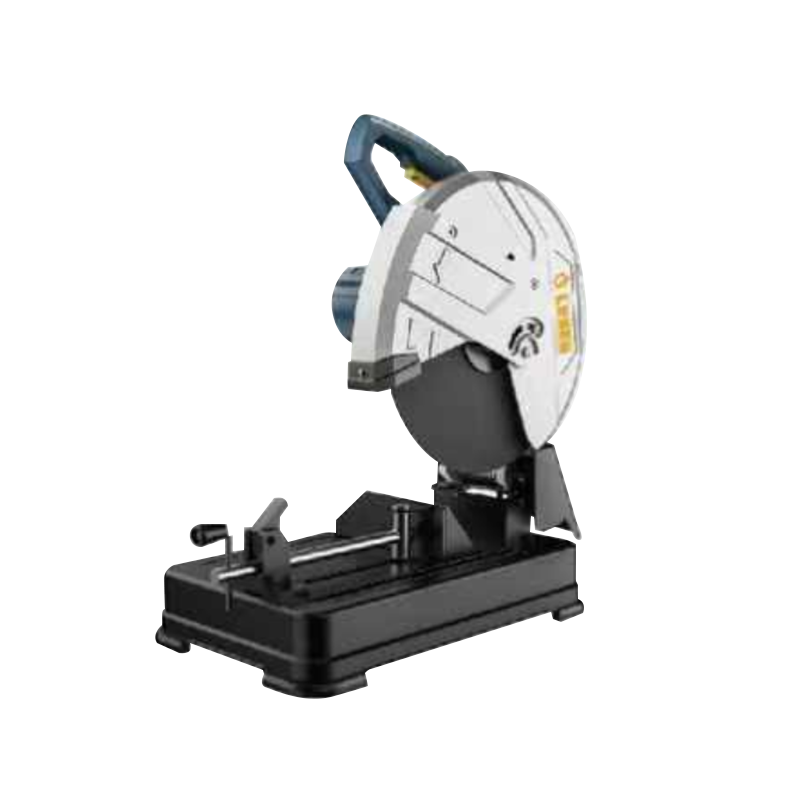
7355-7 High Precision Industrial Metal Cutting Machine Chop Saws
Designed for High-Accuracy Metal Cutting
Industrial metal cutting often involves more than separating material into two pieces. Cut faces may need to fit against other components, align with welded assemblies, support bolted connections, or meet dimensional requirements established by a fabrication drawing. An inconsistent cutting path can create gaps, misalignment, excess grinding, or additional machining. For this reason, accuracy is a major consideration when selecting a chop saw for professional use.
The 7355-7 addresses this requirement through a precision-oriented motor and a reinforced frame. The high-speed motor is intended to maintain a stable cutting action while minimizing unnecessary vibration. Lower vibration can help the operator control the machine more effectively and may contribute to cleaner, more consistent cuts when the correct blade, workpiece support, and operating technique are used.
The reinforced heavy-duty frame provides a rigid foundation for the motor, blade assembly, guard, and workholding components. During the cutting of thick or hard metals, the machine experiences mechanical forces that can cause movement or deflection in a less robust structure. A more stable frame helps keep the cutting assembly aligned and gives the operator a firmer platform for controlled work.
Precision is also supported by the machine’s adjustable cutting arrangement. Straight cuts are suitable for common stock preparation, while bevel and multi-angle capabilities support more complex fabrication tasks. This flexibility reduces the need to reposition material repeatedly or transfer it to a separate machine for every angled cut.
Core Specifications and Their Practical Meaning
The specifications of the 7355-7 describe the machine’s intended operating range and provide a useful basis for evaluating whether it is appropriate for a particular workshop or production process. Actual cutting results depend on material type, profile, hardness, blade selection, workpiece support, and operator technique. Nevertheless, each specification contributes to the machine’s overall capability.
| Specification | Rated Value | Practical Significance |
| Rated power | 2600W | Provides substantial power for demanding metal cutting applications when operated with suitable blades and controlled feed pressure. |
| Maximum sawing depth | 110mm | Supports the cutting of relatively substantial metal sections within the machine’s intended operating range. |
| Saw blade diameter | 355mm | Provides a large cutting format suitable for industrial chop-saw applications and compatible blade selection. |
| No-load speed | 4100r/min | Enables a fast blade rotation for efficient cutting, subject to the requirements of the selected blade and material. |
| Rated voltage | 220V | Designed for compatible 220V electrical systems and installations. |
| Rated frequency | 50Hz | Configured for compatible 50Hz power supplies. |
The 2600W rated power gives the machine a strong electrical and mechanical foundation for production cutting. A powerful motor can help maintain cutting performance when the blade engages larger sections, but it should not be treated as a reason to force the blade through material. Correct feed pressure remains important. Excessive force can increase heat, reduce blade life, and compromise the quality of the cut.
The 355mm blade diameter and 110mm maximum sawing depth make the machine suitable for a wide range of metal stock used in fabrication and construction. These figures should be considered together with the geometry of the workpiece. The maximum depth that can be achieved in practice may vary according to whether the material is round, square, rectangular, flat, or irregular. Operators should consult the machine’s operating instructions and confirm the appropriate cutting method before processing unfamiliar sections.
The 4100r/min no-load speed supports rapid blade movement and efficient material separation. No-load speed is measured without cutting resistance, so the operating speed under load may differ. The selected blade must always be compatible with the machine’s speed rating, diameter, arbor arrangement, and intended material.
Precision Motor Technology for Consistent Work
The motor is one of the most important elements in any chop saw because it determines how effectively the machine can maintain blade movement under cutting load. Inconsistent power delivery may lead to reduced productivity, rougher cuts, or greater operator effort. The motor system in the 7355-7 is designed to provide high-speed cutting performance with an emphasis on stable operation.
A precision motor can help the blade maintain a controlled cutting path when the workpiece presents changing resistance. Metal profiles are not always uniform. A blade may encounter a thin edge, a broad face, a weld, or a harder section during a single cut. A motor with sufficient power and a stable mechanical arrangement can help the operator manage these variations without relying on excessive downward pressure.
Reduced vibration is another important benefit. Vibration can affect cut quality, make the machine more tiring to use, and accelerate wear on certain components. The combination of a balanced motor system, rigid frame, secure blade installation, and appropriate workholding is intended to reduce unnecessary movement during operation.
In comparison with basic or lightly constructed chop saws, the 7355-7 is positioned for users who need more than occasional cutting capacity. A lighter machine may be adequate for intermittent household work, but industrial users commonly require repeated cuts throughout a shift. For these users, motor stability and structural durability can be more valuable than a low initial purchase price alone.
Reinforced Heavy-Duty Frame
Frame construction directly affects how a cutting machine responds to load. When a blade enters thick metal, cutting forces are transferred through the blade assembly, motor housing, pivoting mechanism, base, and workpiece support. If the frame flexes, the blade may deviate from the intended path. Even small movements can become significant when producing a series of parts that must fit together accurately.
The 7355-7 uses a reinforced heavy-duty frame intended to provide stability during demanding operations. The frame helps reduce deflection and supports a controlled relationship between the blade and the workpiece. This is particularly important when cutting thick steel sections, alloy materials, copper rods, aluminum panels, and other stock that may generate substantial resistance.
A stable frame also supports repeatability. Once the operator establishes the required angle and workholding position, the machine can be used to produce a series of similar cuts with fewer adjustments. Repeatability can reduce variation between parts and limit the amount of post-cut correction required during assembly or welding.
Compared with entry-level machines designed primarily for occasional use, a reinforced industrial structure offers advantages in continuous or high-frequency work. It may better tolerate the mechanical demands associated with repeated operation, provided that the machine is used within its rated capacity and maintained correctly.
Structural strength is not limited to the base. The workpiece support, pivot area, guard mounting points, and blade-retention system all contribute to the overall rigidity of the machine. Industrial performance depends on the complete assembly rather than on any single component.
Versatile Cutting Angles for Fabrication Work
Many fabrication tasks require more than a simple 90-degree cut. Frames, brackets, support structures, pipe assemblies, machine components, and architectural metalwork may require bevels or compound positioning. A machine that supports adjustable cutting angles can simplify these operations by allowing the operator to complete different cuts on one platform.
The 7355-7 supports straight, bevel, and multi-angle cutting applications. Straight cuts are useful for preparing stock to length, while angled cuts can support mitre joints, frame construction, pipe fitting, and specialized fabrication. The ability to adjust the cutting position also helps users adapt the machine to different project requirements without purchasing several dedicated tools.
Angle guides make positioning more intuitive. Clear guides can reduce setup time and help operators reproduce a selected angle across multiple workpieces. For production use, the ability to return reliably to a commonly used setting is especially valuable. It can support a more organized workflow and reduce the risk of angle variation between parts.
Operators should verify the selected angle before beginning a production batch. A trial cut on sample material is recommended when a particular fit, joint, or assembly tolerance is important. The quality of an angled cut depends not only on the angle setting but also on material support, blade condition, clamping, and the stability of the workpiece.
Operator-Friendly Design and Faster Setup
Industrial productivity is influenced by every stage of the work cycle, including preparation, positioning, cutting, inspection, and adjustment. A machine that is powerful but difficult to set up may still create delays. The 7355-7 includes design features intended to make regular operation more efficient.
An ergonomic handle gives the operator a practical control point for lowering and raising the cutting assembly. A comfortable and secure grip can improve control during the cutting motion and reduce unnecessary strain during repeated work. Ergonomics are particularly relevant in production environments where operators may complete many cycles during a shift.
Intuitive angle guides assist with rapid positioning. Rather than relying entirely on separate measuring tools for every cut, the operator can use the machine’s integrated adjustment system for common cutting angles. This can shorten setup time and make the workflow more consistent between operators.
The quick blade-change system is another productivity-focused feature. Blade replacement is a normal part of metal cutting. Blades may become worn, require replacement for a different material, or need to be removed for inspection and maintenance. A system that simplifies blade changes can help reduce downtime, provided that the blade is installed correctly and all safety procedures are followed.
Ease of use should not be confused with a reason to skip inspection. Before each blade change, the machine should be disconnected from the power supply, and the blade, arbor, retaining components, guard, and surrounding area should be checked. Correct tightening and alignment are essential for safe and accurate operation.
Advantages Over Conventional or Light-Duty Chop Saws
The 7355-7 is intended to compete on a combination of performance attributes rather than on a single specification. Its main advantages over conventional light-duty chop saws can be summarized as power, stability, flexibility, productivity, durability, and safety-oriented design.
Greater Cutting Capacity
With 2600W of rated power, a 355mm blade, and a maximum sawing depth of 110mm, the machine is equipped for substantial metal cutting tasks. This gives professional users a broader operating range than smaller machines designed for thinner or less demanding stock.
Improved Stability
The reinforced frame is intended to reduce deflection and vibration. A stable platform helps the operator keep the blade aligned and supports more consistent results over repeated cuts. This is an important distinction between an industrially oriented machine and a basic tool intended for occasional use.
Better Workflow Flexibility
Straight, bevel, and multi-angle capabilities allow one machine to address a wider range of fabrication requirements. This can reduce the need to move workpieces between multiple cutting tools and may reduce setup complexity for custom projects.
Reduced Secondary Processing
Accurate cuts can help limit grinding, trimming, and corrective fitting. While the amount of secondary processing depends on material and project requirements, a precise cutting system can provide a better starting point for welding, assembly, and machining.
Suitability for Repeated Operation
The heavy-duty structure and industrial motor configuration are intended to support regular use. The machine is not merely positioned as a compact tool for occasional repairs; it is designed for workshops, production environments, and fabrication operations where dependable cutting is part of the daily workflow.
Practical Operator Controls
An ergonomic handle, angle guides, quick blade-change system, protective guards, emergency stop features, and automatic blade locking address both productivity and control. These elements help create a more organized operating process when used according to the manufacturer’s instructions.
Applications Across Industrial Environments
Industrial Workshops
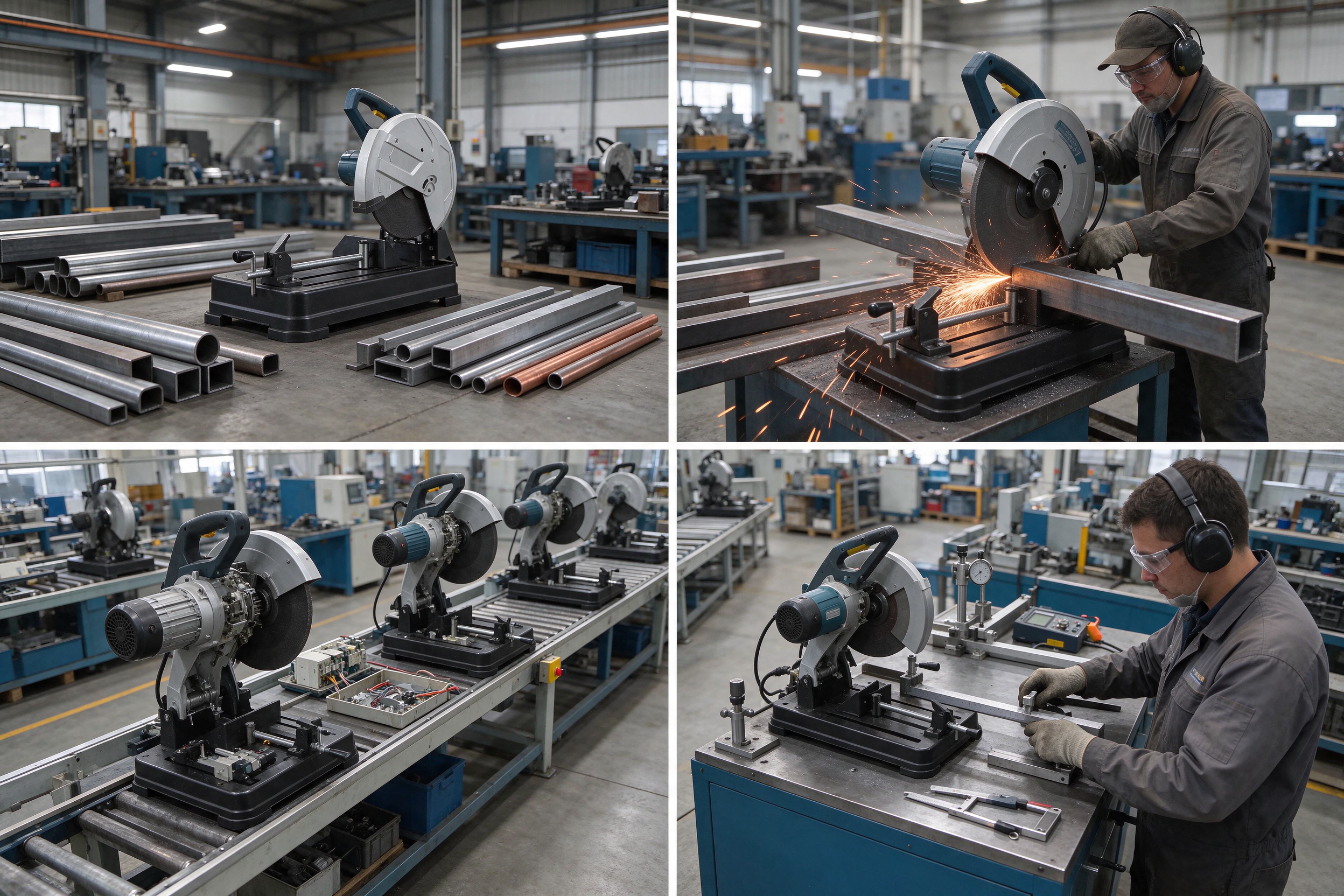
General industrial workshops often process a mixture of steel beams, aluminum sections, copper rods, alloy stock, and fabricated components. A versatile chop saw can serve as a central preparation tool for cutting material before welding, drilling, bending, or assembly.
The 7355-7 is suitable for workshops that need both straight and angled cuts. Its cutting capacity can support stock preparation for repair work, equipment frames, machine guards, brackets, support structures, and custom metal components. The machine’s adjustable angles also make it useful when a workshop handles varied customer requirements rather than a single standardized product.
Manufacturing Facilities
In a manufacturing facility, cutting consistency can affect several downstream operations. If the initial cut is inaccurate, welding fixtures may not align properly, assembly time may increase, and operators may need to perform additional correction. A stable industrial chop saw can help establish a more reliable first stage in the production process.
For batch work, operators can establish a cutting sequence, set the required angle, secure the workpiece, and repeat the process. The machine’s productivity benefits are most apparent when the work is organized around standard material lengths and recurring component designs. Production managers should still monitor blade condition, cut quality, and operating temperature to maintain consistent results.
Specialized Fabrication
Specialized fabricators produce mechanical parts, sheet metal assemblies, custom frames, supports, enclosures, and other components that may not be available as standard products. These operations benefit from a machine that can adapt to different sizes, materials, and cutting angles.
The 7355-7 can support custom work by allowing operators to switch between straight and angled cuts without relying on separate equipment for every requirement. This flexibility is useful for prototypes, replacement parts, small production batches, and made-to-order assemblies.
Construction and Engineering Projects
Construction and engineering work frequently involves cutting structural or semi-structural metal components to suit a specific installation. Accurate preparation can improve fit-up, reduce on-site adjustment, and support more efficient assembly.
When used in a suitable workshop or controlled jobsite environment, the machine can assist with the preparation of steel, aluminum, and alloy components. Operators should assess the electrical supply, ventilation, work surface, material handling requirements, and safety conditions before using the machine on a construction project.
Material Compatibility and Cutting Considerations
The machine is described for cutting steel, aluminum, copper, alloy materials, sheet metal assemblies, beams, rods, and other suitable metal stock. The appropriate blade must be selected for the material. A blade intended for one type of metal may not deliver acceptable results on another, and using an unsuitable blade can reduce performance or create a safety risk.
Steel generally requires a blade and operating method capable of handling high resistance and heat. Aluminum may require attention to tooth geometry, chip clearance, and the possibility of material loading. Copper and softer alloys can behave differently from steel and may require careful feed control. Harder alloys may increase wear and require more frequent inspection.
Workpiece shape also affects cutting. Round stock, square tubing, angle sections, flat bar, pipe, and solid plate present different contact conditions. The workpiece should be positioned so that it remains stable throughout the cut. Unsupported or poorly clamped material can shift, pinch the blade, or affect the accuracy of the result.
Operators should avoid forcing the blade. The correct approach is to allow the blade to perform the cutting while applying controlled, even pressure. If the motor slows significantly, the blade overheats, or unusual vibration develops, the cut should be stopped and the cause investigated.
Safety-Oriented Operating Features
Metal cutting produces sharp edges, hot particles, sparks, noise, and potentially hazardous dust or fumes. Industrial safety requires both machine features and disciplined operating procedures. The 7355-7 includes protective guards, emergency stop features, and automatic blade locking as part of its safety-oriented design.
Protective guards help shield the operator from the moving blade and direct some sparks and debris away from the immediate cutting area. Guards should never be removed, defeated, or held open during operation. Before use, the operator should confirm that the guard moves correctly and returns to its intended protective position.
An emergency stop feature provides a rapid method of stopping the machine in an abnormal situation. Operators should understand its location and function before beginning work. Emergency controls are not a substitute for correct setup, but they provide an important additional layer of protection.
Automatic blade locking can help secure the blade during certain operating or adjustment conditions. The operator should still disconnect the machine from its power source before maintenance, cleaning, or blade replacement. Locking features should be inspected if they show signs of wear, damage, or improper engagement.
Appropriate personal protective equipment should include eye protection, hearing protection, suitable work clothing, and task-appropriate hand and foot protection. Loose clothing, jewelry, and unsecured hair should be kept away from moving parts. The work area should be clear of combustible materials and should provide adequate lighting and ventilation.
Manufacturing Strengths Behind the Product
The performance of an industrial cutting machine depends heavily on the quality of its manufacturing process. The producer of the 7355-7 is a professional tool manufacturing company with a history in tool motor production and mobile cutting machines. Its development has progressed from early imitation toward product innovation, dedicated research and development, and larger-scale production.
The company operates an intelligent production factory covering approximately 30,000 square meters and maintains six main production lines. This scale supports organized manufacturing, production planning, quality control, and more consistent delivery for international customers. A larger production environment can also make it easier to separate processes such as casting, machining, assembly, testing, packaging, and logistics.
In-house manufacturing capabilities are another important strength. The company reports its own foundry and processing plant, advanced testing equipment, and custom production capabilities. These resources can provide greater control over critical components and allow engineering teams to respond more effectively to product requirements.
For a chop saw, manufacturing control is relevant to the frame, motor components, blade mounting elements, protective guards, electrical assemblies, and adjustment mechanisms. Consistency in these parts supports the final machine’s alignment, stability, and operating reliability. When a manufacturer can coordinate design, processing, assembly, and inspection, it may be better positioned to identify and correct process variation.
Research and development also contributes to product improvement. A dedicated R&D team can evaluate motor performance, vibration behavior, structural strength, user ergonomics, guarding, and production efficiency. The goal is not simply to increase power, but to create a balanced machine that performs effectively under realistic industrial conditions.
Quality Control and Testing Approach
Quality control for a metal cutting machine should address both individual components and the assembled product. Component inspections may include dimensional checks, material verification, surface inspection, electrical testing, and fit checks. Assembly inspections may include blade alignment, guard operation, switch function, angle adjustment, clamping behavior, and no-load running performance.
Testing equipment allows a manufacturer to evaluate whether products meet internal standards before shipment. For a high-speed machine, testing is particularly important because the blade assembly, motor, and frame must work together safely. Testing can help identify abnormal noise, excessive vibration, electrical irregularities, or mechanical interference.
Production-line procedures can also improve repeatability. Standardized work instructions help ensure that operators follow the same assembly sequence and torque requirements. Inspection points placed throughout the production process can identify problems earlier than a final inspection alone.
Customers purchasing industrial equipment should ask about inspection procedures, spare parts, technical documentation, electrical configuration, packaging, and after-sales support. These factors are part of the practical value of the machine, especially when it will be used in a production environment where downtime affects delivery schedules.
Customization and International Supply Capability
Different markets and customers may require different electrical specifications, packaging methods, labeling, accessory combinations, or production configurations. The manufacturer’s custom production capabilities provide a basis for discussing project-specific requirements before an order is placed.
Because the listed machine is rated at 220V and 50Hz, buyers should confirm compatibility with the intended installation. Electrical requirements can vary by country, facility, and application. Voltage and frequency should be verified before shipment and installation, particularly for international orders.
The company reports trade coverage in more than 35 countries and regions, as well as 24-hour service response. International experience can help with communication, documentation, export packaging, and coordination with distributors or industrial buyers. However, buyers should confirm the exact service arrangements, response channels, warranty terms, and spare-part availability for their market.
On-time delivery is also important for industrial customers. The availability of multiple production lines and organized manufacturing capacity can support larger orders and repeat purchasing. For distributors, this may help maintain inventory. For factories, it can support equipment replacement programs or expansion plans.
How the Machine Supports Productivity
Productivity is influenced by cutting speed, setup time, rework, operator fatigue, maintenance, and machine availability. The 7355-7 addresses several of these factors through its motor power, blade size, angle adjustment, ergonomic control, and quick blade-change arrangement.
Rapid cutting can shorten the time required to prepare material, but speed must be balanced against accuracy and blade life. A fast cut that creates excessive burrs or requires substantial grinding may not improve the total production cycle. The objective is controlled productivity: completing the cut efficiently while preserving the quality required for the next process.
Angle guides can reduce repeated measuring. A stable workholding area can reduce repositioning. A quick blade-change system can shorten planned maintenance. A durable frame can reduce interruptions associated with instability or misalignment. Together, these features can contribute to a smoother workflow.
The machine may be particularly valuable for operations that process varied materials and small-to-medium batches. In such environments, flexibility and quick setup can be more important than the specialization of a single-purpose automated cutting line. For high-volume applications, the machine can also serve as a reliable preparation station when its capacity matches the production requirements.
Recommended Operating Workflow
Pre-Operation Inspection
Before switching on the machine, inspect the power cable, plug, switch, guard, blade, retaining hardware, base, workpiece support, and emergency stop function. Confirm that the blade is suitable for the material and that its speed rating is compatible with the machine.
Workpiece Preparation
Measure the material and mark the intended cut. Remove loose debris, oil, or contaminants that could affect clamping. Position the workpiece so that the cut-off section is supported and cannot fall into the blade path or cause unexpected movement.
Angle and Clamp Setup
Set the required cutting angle using the machine’s guides. Secure the workpiece firmly without distorting thin material. For repeated cuts, verify the first piece before continuing with the batch.
Controlled Cutting
Start the machine and allow the blade to reach operating speed before engaging the material. Lower the cutting assembly smoothly and apply controlled pressure. Do not twist the blade or force it sideways. If unusual vibration, noise, smoke, or excessive resistance occurs, stop and inspect the setup.
Post-Cut Inspection
After the cut, allow the blade to stop completely before moving the material. Inspect the cut face for unacceptable burrs, deformation, angle variation, or signs of overheating. Record recurring issues and investigate blade selection, clamping, feed rate, or machine condition.
Maintenance and Long-Term Reliability
Regular maintenance helps preserve accuracy and extend service life. The machine should be kept clean, especially around the blade guard, motor ventilation areas, workpiece support, and adjustment mechanisms. Metal chips and dust can interfere with movement and may contribute to premature wear if allowed to accumulate.
Blade condition should be monitored throughout the workday. A dull or damaged blade may require more pressure, generate more heat, and produce rougher cuts. Continuing to use a damaged blade can place additional stress on the motor and other components. Replace blades according to their condition and the requirements of the application.
Fasteners, adjustment points, electrical connections, and guards should be inspected at appropriate intervals. Any loose, cracked, bent, or damaged component should be repaired or replaced before continued operation. Lubrication requirements should follow the manufacturer’s instructions, since excessive or incorrect lubrication can attract abrasive debris.
For production facilities, a preventive maintenance schedule can reduce unexpected downtime. The schedule may include daily cleaning, weekly inspection, periodic electrical testing, blade checks, frame and pivot inspections, and documentation of repairs. Maintenance records also help identify patterns such as frequent blade wear or recurring alignment problems.
Selection Guidance for Buyers
The 7355-7 is a strong candidate for buyers who require an industrial metal cutting machine rather than a basic occasional-use saw. Before purchase, users should evaluate the typical materials, largest workpiece dimensions, required angles, production volume, available electrical supply, workspace, ventilation, and service expectations.
Buyers should also consider whether the machine will be used by one trained operator or by multiple shifts. If several operators will use the equipment, clear procedures and training are especially important. The machine’s ergonomic design and intuitive guides can support consistency, but proper training remains necessary.
For distributors and importers, product documentation, packaging, spare blades, replacement components, warranty policies, and shipping terms should be confirmed. For factories, the discussion should include commissioning, electrical installation, operator training, preventive maintenance, and expected delivery schedules.
A responsible purchasing decision should compare the complete operating value rather than only the initial price. Motor power, frame strength, cutting flexibility, downtime, blade consumption, service support, and the cost of secondary processing all affect the total cost of ownership.
Frequently Asked Questions
What type of machine is the 7355-7?
The 7355-7 is a high-precision industrial metal cutting machine chop saw designed for cutting suitable steel, aluminum, copper, alloy, and other metal materials. It is intended for workshops, fabrication facilities, manufacturing operations, construction-related preparation, and engineering applications.
What is the rated power of the machine?
The rated power is 2600W. This provides a substantial power level for demanding metal cutting work when the machine is paired with a suitable blade and operated with controlled feed pressure.
What blade diameter does it use?
The listed saw blade diameter is 355mm. The replacement blade must be compatible with the machine’s diameter, arbor arrangement, speed rating, and the material being cut.
What is the maximum sawing depth?
The maximum sawing depth is listed as 110mm. Actual capacity may vary according to workpiece shape, material, blade selection, angle, and operating conditions.
Can the machine make angled cuts?
Yes. The machine supports straight, bevel, and multi-angle cutting applications. The operator should use the angle guides, secure the workpiece, and verify the angle with a trial cut when precise fit-up is required.
What is the no-load speed?
The no-load speed is 4100r/min. This is the blade speed without cutting resistance. The operating speed under load can differ, and the blade must be rated for compatibility with the machine.
What electrical supply does it require?
The listed electrical configuration is 220V and 50Hz. Buyers should confirm the actual supply requirements and regional compatibility before installation or ordering.
Is it suitable for continuous industrial work?
The machine is designed for industrial environments and features a reinforced heavy-duty frame, a powerful motor, and productivity-oriented controls. Its suitability for a specific continuous-duty schedule depends on material, workload, operating practices, ventilation, maintenance, and compliance with the manufacturer’s instructions.
What safety features are included?
The described safety-oriented features include protective guards, emergency stop functions, and automatic blade locking. These features must be used together with appropriate personal protective equipment, training, correct workpiece clamping, and regular inspection.
How does it compare with a basic chop saw?
Compared with a light-duty model, the 7355-7 offers a higher industrial power rating, a larger 355mm blade format, a stated 110mm maximum sawing depth, reinforced frame construction, multi-angle capability, and features intended to support repeated work. The most appropriate choice depends on the user’s material, production volume, and required cutting capacity.
What should be checked before changing the blade?
The machine should be switched off and disconnected from the power supply. The blade guard, retaining hardware, arbor area, blade condition, and replacement blade compatibility should be checked. After installation, verify correct alignment, secure tightening, guard operation, and a safe no-load test before cutting material.
Can the manufacturer support customized orders?
The manufacturer reports custom production capabilities, multiple production lines, in-house processing resources, and international supply experience. Buyers should discuss customization, electrical configuration, packaging, accessories, labeling, documentation, delivery, and service requirements before confirming an order.
Conclusion
The 7355-7 High Precision Industrial Metal Cutting Machine Chop Saw is designed to address the practical demands of professional metalworking. Its 2600W motor, 355mm blade, 110mm maximum sawing depth, and 4100r/min no-load speed provide a strong foundation for industrial cutting. The reinforced frame supports stability, while the adjustable cutting arrangement helps users complete straight, bevel, and multi-angle work on one machine.
Its advantages over lighter conventional chop saws extend beyond power. The combination of precision motor technology, reduced vibration, heavy-duty construction, ergonomic control, intuitive angle guides, quick blade changes, protective guarding, emergency stop functions, and automatic blade locking creates a more complete industrial tool solution. These features can help improve accuracy, reduce setup time, support repeatability, and limit secondary processing when the machine is used correctly.
The manufacturing capabilities behind the product are also important. Research and development resources, six main production lines, a large intelligent factory, an in-house foundry and processing plant, advanced testing equipment, custom production capability, and international service experience provide a solid foundation for supplying professional customers. For workshops, manufacturers, fabricators, contractors, and distributors seeking a dependable metal cutting platform, the 7355-7 offers a balanced combination of capacity, flexibility, durability, and production-oriented design.
As with any industrial machine, the best results depend on correct blade selection, safe workholding, proper electrical installation, operator training, routine maintenance, and operation within the specified limits. When these requirements are respected, the 7355-7 can serve as a reliable part of a modern metal fabrication workflow.
References
1. Product specification sheet for the 7355-7 High Precision Industrial Metal Cutting Machine Chop Saw.
2. Product information covering rated power, maximum sawing depth, saw blade diameter, no-load speed, rated voltage, and rated frequency.
3. Manufacturer-provided information concerning industrial applications, product features, and operator safety functions.
4. Manufacturer company profile describing research and development, production lines, factory facilities, custom manufacturing, testing equipment, and international supply capability.
5. General industrial metal cutting and machine safety principles concerning blade selection, workpiece support, guarding, personal protective equipment, maintenance, and controlled feed operation.